



Metrology Glossary: Accuracy

What Is Accuracy?

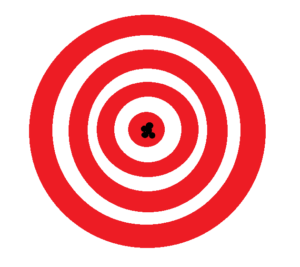
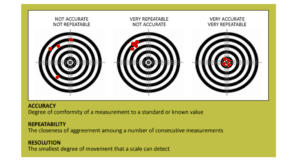
Accuracy is the extent to which a measurement aligns with the actual value of the quantity being assessed. It is commonly represented as a percentage relative to a standard reference. For instance, an accuracy of 95% indicates that the measurement falls within 5% of the true value. Several factors can influence measurement accuracy, including the quality of the measuring tool, the proficiency of the individual conducting the measurement, and the environmental conditions during the measurement process.

Why is Accuracy Important?

Accuracy is a crucial concept within multiple fields including:

  • Engineering and Manufacturing: accuracy in measurements holds significance in both the design and manufacturing stages within engineering processes. Whether conceptualizing bridges or fabricating intricate components, precision emerges as a pivotal factor in guaranteeing the quality and safety of products, contributing to their optimal functionality and reliability.
  • Scientific Research: In scientific research, accuracy stands as a fundamental prerequisite for acquiring valid and replicable data. Accurate measurements help scientists to derive meaningful insights into their research.
  • Medical devices: Accuracy is crucial for medical devices particularly in diagnostic procedures and treatment decisions. Accurate medical assessments, such as blood pressure, blood glucose levels, and medication dosages metrics, are imperative for delivering impactful and dependable patient care.
Laboratory Equipment Calibration

Related Terms

Products and Services

Further Reading

Accuracy & Precision
In metrology, using the correct terminology can be critical in getting the measurement information required. Three terms that are often incorrectly used interchangeably are accuracy, precision, and resolution.
February 23, 2018
Cross Logo
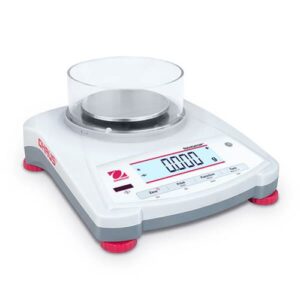
Navigator™ Multi-Purpose Portable Balances from Ohaus
Even if your balance is calibrated on a regular interval, there are several factors that could be impacting the accuracy and repeatability of your measurements on a day to day basis. The location and environment that your balance is used in can have an effect on repeatability –even if the
July 25, 2017
Cross Logo
Accuracy, repeatability, and resolution infographic
The terms accuracy, repeatability, and resolution can be found on the spec sheets of many engineered products. They are often misunderstood, used interchangeably, or just plain confused. This can cause products to be incorrectly specified and, in many
January 21, 2020
Cross Logo

Glossary Tags

Browse our Terminology Glossary

#

A

B

C

D

E

F

G

H

I

J

K

L

M

N

O

P

Q

R

S

T

U

V

W

X

Y

Z

See how our team can help improve efficiency, reduce risk, and raise quality in your process.

Contact our Team

"*" indicates required fields

This field is for validation purposes and should be left unchanged.
What can we help you with today?*

Where Can We Send Your Information?

Name*
Company Location*
This field is hidden when viewing the form
Form Type
This field is hidden when viewing the form

Hang Tight! We're Searching... Searching... Searching...

We’re looking through thousands of pages to find the most relevant information.

In the meantime, enjoy these fun facts…

Did you know… Cross Company is an ESOP (Employee Stock Ownership Plan). Our ESOP started in 1979 and as of 2006, we are 100% employee-owned! Learn more about our ESOP and how that benefits both team members and our customers.
Did you know... the precision measurement group at Cross was founded in 1939 by our current CEO's grandfather, Jim King. That's a whole lot of calibration!
Did you know... A fingerprint weighs about 50 micrograms. We know, we weighed it! The residue left from a finger can actually make a difference in weight results which is why we wear gloves when we calibrate weights. For reference, a sheet of paper is about 4.5 grams, that’s 4.5 million micrograms.
Did you know… Cross Company has grown significantly since our start in 1954. Over the years we've acquired 26 companies! Today, our five groups have expertise in everything from industrial automation to precision measurement, and industry knowledge going all the way back to 1939.