Choosing the right equipment for your application can be difficult. Flow measurement applications are no exception. Though it might seem straight forward to choose flow meters, the answer is not always quite so simple. There is a strong case to be made for measuring based on weight. When deciding between flow meters and load cells for your flow measurement application, there are a number considerations to take into account.
Application
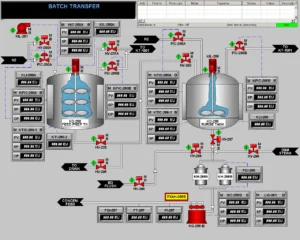
Because flow meters measure the flow of a material as it passes through a specific point, they are generally better suited for continuous flow applications. While flow meters can tell you quite precisely how much liquid has traveled through a hose or pipe based on rate of flow, they cannot necessarily speak to the exact amount that is currently in a tank or vessel. For this reason, start/stop applications such as batching are generally a better fit for load cells, as they can accurately tell you exactly how much of a material has been added to your mixture.
One notable exception is when one ingredient is added in a relatively low quantity. If you are mixing a large batch, but need to add a very small amount of a concentrated ingredient it may be better to add that one ingredient using a flow meter. If not, to accurately measure that ingredient you might need to create a secondary weight measurement setup on the ingredient tank. With multiple ingredients, that could quickly add substantial cost.
In general, flow meters take a more analytical approach to measurement which can prove beneficial for those smaller quantities. In addition to gaining the resolution and accuracy which your load cell system may not permit, flow meters could be more cost effective than a complex weight measurement system.
On the other hand, load cells are great solution for larger material quantities and industrial settings. For applications involving simple ingredient mixtures or corrosive ingredients, which we’ll get into later, load cells are a lower maintenance solution for flow measurement, and can prove easier to manage and cost effective over time.
Material
The materials that you plan to measure are an important consideration when choosing equipment. If your process includes materials that are dry, contain air or bubbles, or are highly corrosive, load cells will likely be a better fit. Dry materials and liquids that contain air or bubbles such as foam or carbonation, can cause issues for flow meters as their rate of flow may not be consistent. This would have no impact on a load cell system, as it is solely based on weight. Likewise, if you are measuring a corrosive substance such as sulfuric acid, your options of flow meters that will not be damaged by the substance are fairly limited, while load cells under the holding tank would be unaffected.
Configuration/Installation
In order to use load cells, your tanks must be isolated. For the system to give accurate measurements, you will need flexible hoses or pipes to deliver your material to and from the tanks. You will also need to minimize vibrations from surrounding equipment and processes. Flow meters, on the other hand, do not require flexible hoses and are not affected by vibration.
Another common argument for flow meters is that multiple flow meters allow for the addition of multiple ingredients at once, while the use of load cells require ingredients to be added one at a time. While this is true, if load cells are mounted under the ingredient tanks instead of the batching tank, a well configured system could add multiple ingredients at once with no problem.
Calibrations
Put simply, calibrating a flow meter is significantly more complicated than calibrating load cells. From finding a qualified service provider to ensuring your measurements are accurate, it is likely that you will have a more difficult time with flow meters than you would with a load cell system. Click to learn more about flow calibrations.
Why Partner With Cross Company?
In the field of metrology, there are many standards to follow to ensure reliable calibration or inspection. At Cross Precision Measurement, we are an ISO 17025 accredited calibration laboratory that adheres to standards set out by NIST (HB44), the National Conference on Weights and Measures (NCWM), the National Type Evaluation Program (NTEP), A2LA, and other relevant standards. With our experience and expertise, we can ensure you’re getting reliable, repeatable metrology results.
Since 1939, our Precision Measurement group has provided industry-leading technical expertise coupled with world-class customer service to manufacturing and other industrial operations in need of onsite calibration, product inspection, precision measurement equipment, and more. Our precision measurement and inspection teams have the knowledge and resources to help you reduce risk, improve quality, and increase efficiency throughout your entire process. With our extensive network of calibration labs across the Southeast and Midwest, we can ensure you’re getting the metrology services you need. Contact Cross Precision Measurement today