Retrofitting Legacy Hardware for Digital Precision and Auditable Data
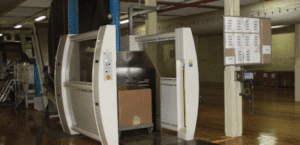
A global leader in food ingredients provides micro-ingredient feeders to flour and corn mills to facilitate the addition of enrichments, bleaching products, and other additives. To address increasing customer requirements for precision and data logging, the manufacturer partnered with Cross to modernize these systems by retrofitting established hardware with advanced sensing and control technology. Over six plus years, this collaboration successfully transitioned the equipment from manual “dial-in” operations to a sophisticated, automated loss-in-weight system.
Problem: The Challenges of Manual Dosing
For years, the feeders provided to flour mills relied on manual control and spot checks. An operator would dial in a percentage on a controller, estimating that a corresponding amount of material was being added to the flour based on pre-calibrated speeds. There was no real-time way to verify the exact amount of ingredient dropped.
The old system faced increasing pressure from several angles:
- Customer Demand: Flour mills, driven by their own quality departments, began asking for finer control and quantifiable verification of ingredient application. They needed specific, auditable numbers.
- Recipe and Regulatory Needs: Over- or under-enrichment directly impacts product consistency, performance, and regulatory compliance.
- Efficiency and Modernization: Mills operate across a technology spectrum, requiring a solution capable of automating standalone operations or integrating with larger plant networks via Programmable Logic Controllers (PLCs).
The Core Constraint
Our customer did not want to redesign its existing feeders, as hundreds of units were already deployed and in inventory across North America. The challenge was finding a way to transform this existing hardware into a precise, automated, and intelligent solution without starting from scratch.
“We had customers requesting this loss-in-weight technology for our ingredient addition systems,” said the company’s Sales Manager. “That’s not something we necessarily specialize in; we’re more of the ingredients side and provide equipment. Cross are the technical experts in making the software and this all work.”
Solution: Engineering the Retrofit
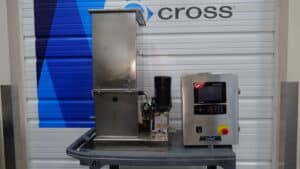
Cross engineered a solution that retrofitted the customers existing feeders rather than replaced them. The system places the standard feeder directly onto a high resolution industrial scale base paired with a programmable digital weight indicator.
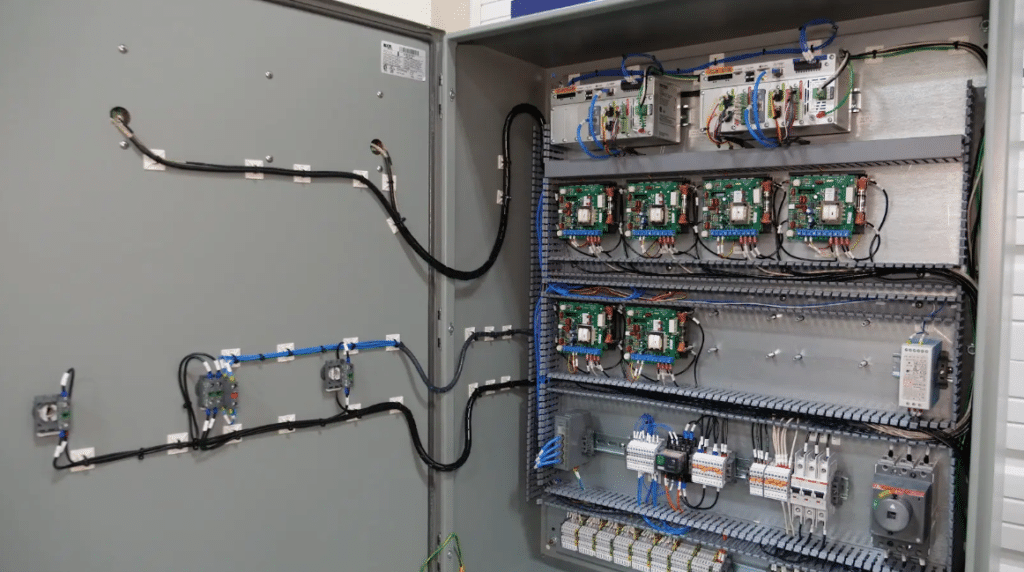
The Custom Software
The innovation lies in the custom software Cross developed to convert the manual feeder into a smart, loss-in-weight system:
- It uses weight data from the scale base to calculate the precise feed rate.
- It dynamically adjusts motor speed to match a target feed rate, compensating for material density or humidity changes.
- It enables monitoring and alerting for empty feeders or out-of-tolerance feeding.
- An “automatic tracking” feature pauses weight monitoring during refills to ensure continuous accuracy.
Gram-Level Precision and Visibility
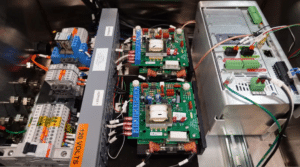 By applying a 10-minute rolling average to the scale data, the system successfully translates raw mechanical increments into a stable, accurate feed rate with gram-per-minute precision. Operators simply enter a target feed rate, and the system manages the rest. Because every gram is accounted for and logged by the controller, millers now have a complete digital paper trail for every load. This provides the auditable data and traceability required for modern quality standards, allowing customers to verify enrichment levels with absolute confidence.
The system has improved how technicians and customers interact with the machinery. “It gives our technicians much better insight into what’s actually going on with our systems out in these plants. They can control everything they need to from a standalone controller, and we can see a lot more into the process than we could with systems that weren’t using this technology,” notes the Sales Manager.
The technical upgrade directly addresses modern quality and audit requirements. “There is a major focus on traceability now,” the Sales Manager explained. “After technicians finish a load, they can see exactly how much ingredient left that feeder—they have the starting weight and the ending weight. For mock recalls and audits, they know exactly how much product was used during that day.”
A Proven Solution at Scale
By combining industrial engineering with custom software, Cross helped the manufacturer improve customer quality control while maximizing existing asset utilization. Approaching a decade of partnership, the initial prototype has expanded into nearly 200 systems deployed across North America and beyond.
Partnering for Customer Success
Cross engineers continue to work with the customer to refine these systems. The Sales Manager emphasizes the value of this ongoing collaboration: “When we’re in kickoff meetings with customers, having someone like Shaun in our corner to communicate the technical side of the automation is super helpful. It’s a lot easier to problem-solve when we’re out on the road because we can go through our controllers to see exactly what is happening.”
The transition to loss-in-weight technology was a response to the needs of their partners in the milling industry. By listening to the challenges faced by quality control departments and mill operators, the company identified a gap between traditional mechanical feeding and digital precision. “Having that flexibility to work and collaborate with Cross to come up with a solution was great,” said the sales manager. “We’re always looking to put out information and systems that are more user-friendly for our customers, ensuring they have a basic understanding of how these systems work and the confidence that they are getting exactly what they need.”
For those looking to modernize operations with automation, a Cross Automation expert is ready to help.