Key technical insights, safety standards, and operational advantages for mobile machinery OEMs.
1. What is steer-by-wire (SbW) and how does it work?
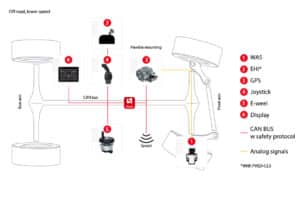 Steer-by-wire (SbW) is a steering technology that completely removes the physical mechanical linkage (such as steering shafts, rack-and-pinion assemblies, or pitman arms) between the steering wheel and the vehicle’s road wheels. Instead of mechanical connections or hydraulic hoses, steer-by-wire systems use electronic sensors to detect driver steering inputs, a digital controller to process the signals, and electric steering motors to turn the wheels. Sensors also send tactile force feedback back to the operator to simulate natural road feel.
2. What is the difference between electric power steering and steer-by-wire?
While both systems use electric motors, the key difference lies in the mechanical connection:
- Electric Power Steering (EPS): Replaces hydraulic power assist with an electric motor, but retains the physical mechanical linkage (steering column, rack, or pitman arm) connecting the steering wheel to the tires.
- Steer-By-Wire (SbW): Completely eliminates the physical steering linkage. Steering commands are transmitted entirely via electrical wires, electronic controllers, and CANbus networks to wheel-actuating motors or electrohydraulic steering valves.
3. What are the advantages of steer-by-wire over mechanical or hydraulic steering?
Replacing traditional mechanical gears and hydraulic power steering with steer-by-wire technology offers several key operational and design benefits:
Weight Reduction & Fuel Economy: Removing heavy mechanical columns, steering boxes, and hydraulic pumps reduces overall machine weight and increases fuel/battery efficiency.
- Zero Hydraulic Maintenance: Eliminates hydraulic fluid leaks, hose routing, pump maintenance, and system pressure adjustments.
- Fewer Moving Parts: Fewer mechanical wear components reduces maintenance downtime and lowers long-term total cost of operation.
- Higher Precision: Electronic controls improve turning accuracy and operational efficiency.
- Improved Operator Ergonomics: Requires significantly less physical effort to steer, drastically reducing operator fatigue over long shifts.
Safety, Regulations & Reliability
4. Is steer-by-wire safe for mobile machinery without a mechanical backup?
Yes. Because steer-by-wire eliminates physical mechanical backups, safety is handled through redundant electronic hardware and strict functional safety standards. Modern off-highway steer-by-wire systems utilize specialized controllers—such as the InMotion APS (Advanced Power Steering) controller or the Danfoss SIL2-certified PVED CLS steering controllers—which meet ISO 13849-1 (Category 3, Performance Level PL=d) and IEC 61508 (SIL2) for functional safety.
5. How do steer-by-wire systems prevent failure if a motor or wire cuts out?
Safety-critical steer-by-wire systems rely on dual-processor architectures and redundant feedback loops:
- Fault Detection Controllers: Safety controllers feature a secondary supervisory processor that monitors the main processor in real time. If a single fault occurs in the controller, input device, or wiring, the system detects it instantly and brings the machine to a controlled, safe stop.
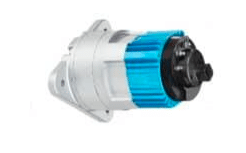
- Redundant Motor Feedback: Steering motors (such as the InMotion PSM series) feature dual position sensors. This redundant feedback ensures the controller always knows the exact angle of the wheels to maintain safe, controlled steering.
Integration & OEM Support
6. Can steer-by-wire integrate with my machine’s existing CANbus network?
Yes. Steer-by-wire controllers are highly flexible and can operate as standalone steering units or integrate directly into a vehicle’s broader CANbus machine control architecture. This flexibility simplifies wiring harnesses and allows steering data to be shared with telemetry, IoT devices, or autonomous driving systems.
7. How do you implement steer-by-wire technology?
 Transitioning a mobile machine from traditional mechanical or electro-hydraulic steering to electronic steer-by-wire requires specialized engineering. Cross Mobile Systems Integration partners with you to design, prototype, and build custom mobile control systems. As members of the National Fluid Power Association (NFPA), Association of Equipment Manufacturers (AEM), and International Fluid Power Society (IFPS), our team helps OEMs select ISO-compliant safety controllers, integrate electric motors or electrohydraulic valves, design CANbus networks, and electrify mobile equipment efficiently.
As a full-line systems integrator for Danfoss, we also implement advanced off-highway steer-by-wire architectures using the Danfoss Flex-Steer system. Unlike fully electric wheel-motor setups, Flex-Steer pairs an electronic haptic steering wheel (e-Wheel 100) or joystick with an electrohydraulic steering valve (like the PVED CLS) and wheel angle feedback sensors. The valve drives the machine’s steering cylinder while feedback is continuously processed by the machine controller. This hybrid electrohydraulic approach is a practical way to deliver steer-by-wire functionality to heavy mobile machinery.
Cross Mobile Systems Integration brings deep expertise in machine electrification, hydraulic design, and mobile control systems, providing the engineering support needed to modernize your equipment safely and efficiently. Whether you want to reduce overall machine weight, eliminate hydraulic maintenance, or improve operator comfort, transitioning to electronic steer-by-wire helps you build cleaner, more efficient mobile equipment. Reach out to the Mobile Systems Integration team today to discuss your application, review prototype requirements, and start designing your next-generation mobile machine.
Check out our latest video on what to expect from Cross as your mobile systems integration partner.