



Automation Glossary: Motion Control
What Is Motion Control?
Motion control refers to the precise management and adjustment of mechanical systems. It involves regulating the position, speed, acceleration, and force of moving components. These systems play a critical role in industrial applications such as robotics, automation, manufacturing, and transportation by ensuring accurate movement. They rely on sensors, actuators, and control algorithms to achieve the required motion with high precision.
What Is Motion Control Used For?
- Robotics: Motion control enables robots to perform intricate and precise tasks, such as assembly, welding, painting, and material handling, ensuring efficiency and consistency in various industrial applications.
- CNC Machining: Provides accurate and detailed control of machine tools to produce intricate and highly precise parts, essential in manufacturing and engineering.
- Pick-and-Place Systems: Supports automated systems to quickly and accurately pick up, transfer, and position objects, enhancing productivity and reducing errors in production lines.
Related Terms
Occupancy detection within vehicles is a technological system engineered to determine the presence and number of individuals inside a vehicle....
A tensile tester is a device designed to quantify the tensile strength of substances, representing the maximum force a material can endure before fracturing under tension....
Further Reading
It is most likely the goal of every company to have Smarter Machines. But what is a “Smart Machine?” Ask 100 people that question and you will probably get 100 different answers. In my opinion the definition of a Smart Machine is pretty simple
October 24, 2019
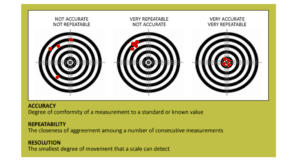
The terms accuracy, repeatability, and resolution can be found on the spec sheets of many engineered products. They are often misunderstood, used interchangeably, or just plain confused. This can cause products to be incorrectly specified and, in many
January 21, 2020