
Starrett Load Cell Sensors
Product Overview
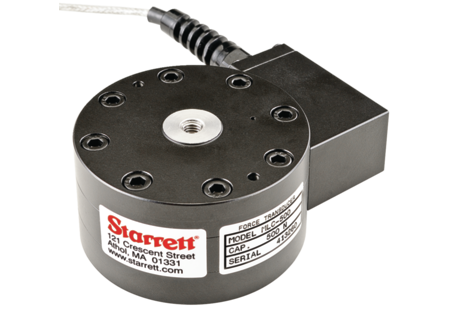
Starrett offers a range of precision load cells that achieve high-accuracy force and material testing across their entire motorized frame lineup. These sensors are not just transducers; they are “Smart Sensors” compliant with the IEEE 1451.4 (TEDS) standard. This means when a load cell is connected to an L-Series system, the software automatically self-configures with the correct model, serial number, and calibration data, ensuring that your testing environment is ready for action in seconds without manual data entry.
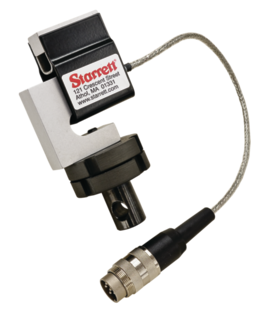
From the economic and compact BLC series for production environments to the “Ultra” low-profile ULC series for high-stiffness material research, Starrett has a sensor for every industrial application. By providing NIST-traceable accuracy and robust overload protection, these sensors ensure that your data is not only precise but repeatable across different operators and shifts.
Features and Benefits
Instant “Plug & Play” Integration: Leveraging IEEE 1451.4 TEDS technology, the system automatically identifies the sensor, raising efficiency by eliminating manual configuration and setup time.
Exceptional Measurement Accuracy: Achieves accuracies of ±0.05% of reading (MLC/ULC) down to 1/100th of sensor capacity, improving quality for critical validation tests.
Automatic Overload Protection: The software monitors load history and provides mechanical stops to lower risk of damaging expensive sensors during unexpected break tests.
High Axial Stiffness: Designed with minimal deflection at full capacity, ensuring that the displacement data captured is the true elongation of the specimen, not frame flex.
Sealed & Industrial Options: Available FLC-Sealed models provide protection against dirt, oil, and debris, making them ideal for non-laboratory manufacturing environments.
Safety & Compliance Tracking: Every sensor includes an onboard memory chip that stores calibration history and overload events, fulfilling the requirements for ISO 9001 and AS9100 quality audits.
Broad Capacity Range: Offers a scalable solution with sensors ranging from 2 lbf (10N) for delicate fiber testing up to 11,250 lbf (50kN) for heavy-duty metal components.
Specifications
Standard Accuracy: ±0.05% of reading (MLC/ULC) or ±0.1% Full Scale (BLC/FLC).
Communication Protocol: IEEE 1451.4 (TEDS) compliant “Smart Sensor” interface.
Available Capacities: 2 lbf (10N) up to 11,250 lbf (50kN).
Safe Overload Rating: 150% of rated capacity (1000% on FLC-Premium models).
Load Cell Types: S-Beam (BLC/FLC), Low-Profile (MLC), and Ultra Low-Profile (ULC).
Calibration Standard: NIST-traceable Certificate of Calibration supplied as standard.
Sampling Rate Compatibility: Supports high-speed sampling up to 2,000Hz when used with L-Series software.
Available In The Following Areas
With an extensive background in a variety of industries, Cross has relationships with a number of leading brands, including exclusive distributorships in some areas. We are proud to offer Starrett in the following areas:
Videos
See how our team can help improve efficiency, reduce risk, and raise quality in your process.
Interested in calibration services? Take a look at the force calibration services offered by Cross.