Large Electromechanical Gripper Options for Heavy Loads

Grippers used in automation vary greatly in size and shape. They can be as small as a pencil eraser, or as large as a car. The largest standard grippers on the market are capable of handling several hundred pounds. But what if you need something bigger? What if you are handling 1,500 lbs? Or what if the part is 10 feet long? Luckily, there is a solution.

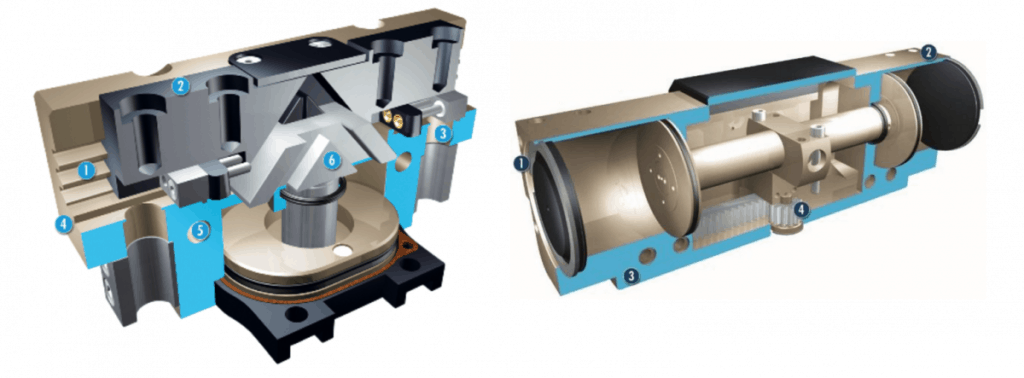
A gripper is essentially a self-centering clamp. It provides a means of generating clamping force while synchronizing the jaws so that they move together. The gripper must also provide a bearing system to handle the weight of the part, as well as the moments generated due to the gripping force. Most of the grippers on the market are actuated pneumatically and they use various methods to synchronize the jaws such as a wedge hook or rack-n-pinion.
 

Large Electromechanical Gripper Options for Heavy Loads 1
Figure 1: SCHUNK Designs – Wedge Hook and Rack & Pinion


Actuating a Large Gripper

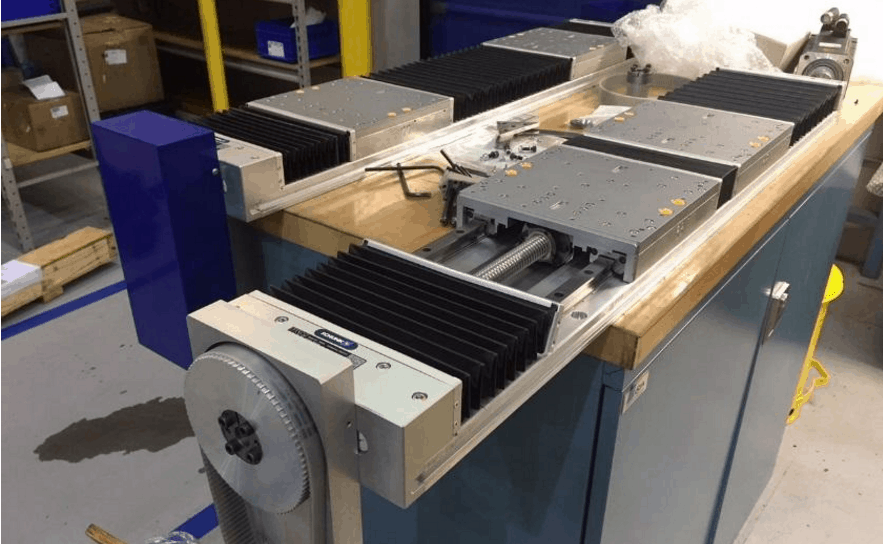
One answer to creating a really large gripper is to use a ball screw actuator. It’s easy to find an actuator with enough thrust force (large diameter screw) and enough bearing load capability (large square rail bearings), but we still need to synchronize the jaws. The answer to that is to use an opposing thread screw. This means that the first half of the screw is a right-hand thread, and the second half of the screw is a left-hand thread. When the motor turns the input shaft, the carriages will move in equal and opposite direction. Now we have the perfect recipe for a really large gripper.
 

Large Electromechanical Gripper Options for Heavy Loads 2
Figure 2: Ball screw gripper with cover pulled back to show screw and rail bearings. Also shown is the motor mounting kit which is commonly done as a parallel mount. The gripper in the back is identical but fully assembled and in a more open position.


The next step is to pick the right sized actuator to make the gripper. The thrust rating of the screw is directly proportional to grip force. The moment load rating of the carriages can be used to determine if the gripper is able to handle to loading caused by the weight of the part and the loading caused by the clamping force. Ultimately, big parts need a big gripper, and that is not a problem for a ball screw gripper. Below are some application examples showing fairly large ball screw gripper.
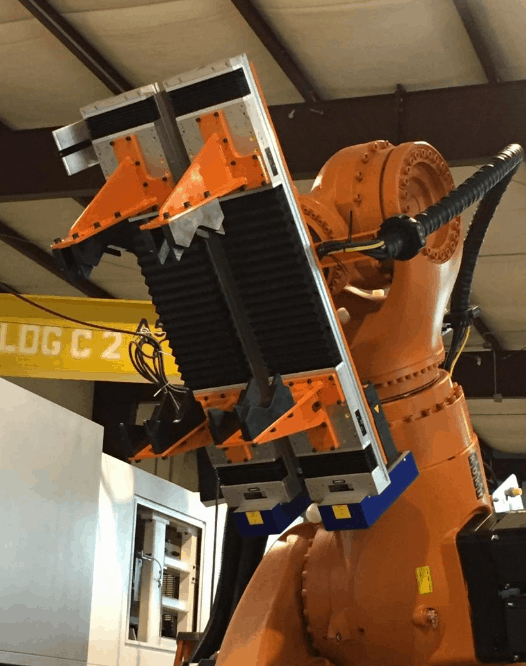
 

fanuc industrial robot
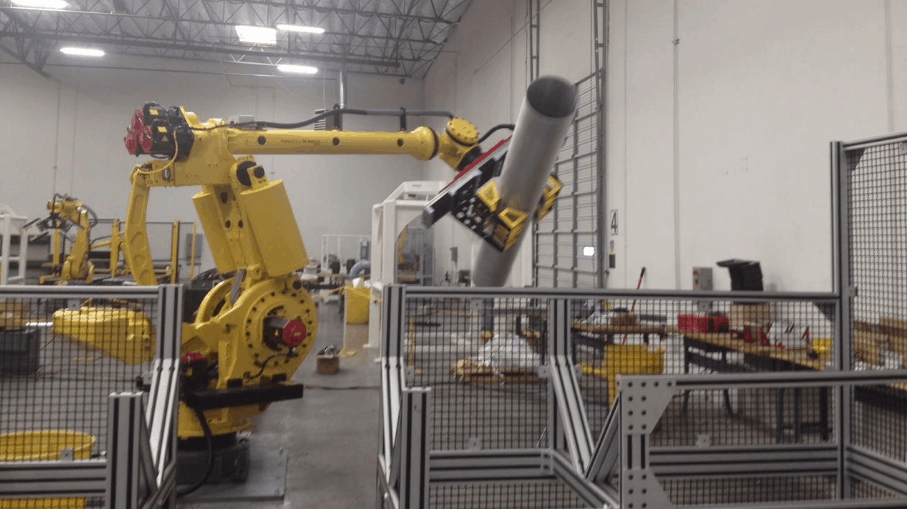
Figure 3: Handling a 400lb corrugated tube that is 10 feet long. Picture courtesy of Fanuc in California.


Large Electromechanical Gripper Options for Heavy Loads 3
Figure 4: Two grippers being used to handle parts over 1,000 lbs. The application is loading a large CNC lathe. Picture courtesy of Hartwig.

Advantages of a Screw-Driven Gripper

This gripper is handling wheel rims for tractors. The large wheel rim weighs 350 lbs and is about 52” in diameter. The smaller wheel rim is only 13” in diameter. This application shows the great stroke range available with these grippers, and also the great moment load capability. The gripper is powered by a servo motor that is controlled by the robot controller. It is an auxiliary axis on the controller and it can be programmed directly from the teach pendant. Having a servo run the gripper allows for position control and some force control. The jaws can be pre-positioned between moves and the force can be limited so the gripper doesn’t squeeze any more than it has to.

Another benefit of using a ball screw gripper is a high mechanical advantage for the motor. Most of these grippers are employed with 5mm lead ball screws and a 3:1 reduction in the belt and pulley drive system inside the motor wrap. That translates to a very high mechanical advantage. Just a few in-lbs of torque at the motor translates to thousands of pounds of thrust at the gripper fingers. That means you don’t need a huge motor to grip very heavy objects. The downside is that a high mechanical advantage will make jaw travel fairly slow. Most of these applications are not very high speed, so it’s an acceptable trade-off. Another nice feature of a ball screw gripper is the ability to customize the length and carriage position. If you are gripping a part that is six feet wide, then if would be nice if the carriages opened up to that six-foot mark so your finger design is simpler and they only need to protrude out straight. This is no problem with a ball screw gripper but almost impossible with any other gripper.

Looking for a gripper for heavy loads? Cross’s Automation experts can help you to select the correct option. Contact us today to discuss your particular application.
Latest Cross Company Resources

Cross Precision Measurement transformed a Tennessee energy facility’s metrology program by deploying a custom mobile calibration lab. Delivering ISO 17025-accredited calibrations directly on-site, Cross eliminated downtime, improved accuracy, and ensured complete audit readiness.
October 5, 2026
Cross Logo
System integrators must test control system configurations. Ideally we thoroughly test them before systems are delivered. Simulating inputs based on outputs is a key tool to perform these tests.
July 28, 2026
Author – Chris Hardy
Cross Logo
A global leader in food ingredients provides micro-ingredient feeders to flour and corn mills to facilitate the addition of enrichments, bleaching products, and other additives. To address increasing customer requirements for precision and data logging, the manufacturer partnered with Cross to modernize these systems by retrofitting established hardware with advanced
June 30, 2026
Cross Logo
production line using servo drive automation
Maximize efficiency and precision in your automation processes. Learn how to optimize your motion control systems with Applied Motion Products from Cross Company.
June 16, 2026
Cross Logo
Stop patching and start planning. Learn how a phased 6-step roadmap for legacy control system modernization reduces risk, spreads costs, and avoids downtime.
April 9, 2026
Cross Logo
katronic logo
Learn how Cross Process Solutions utilized the KATflow 150 to solve water billing inaccuracies and identify steam leaks for a major manufacturer. Discover the advantages of non-invasive ultrasonic technology for continuous industrial processes where system downtime is not an option.
February 9, 2026
Cross Logo

See how our team can help improve efficiency, reduce risk, and raise quality in your process.

Share This Material

Contact our Team

"*" indicates required fields

This field is for validation purposes and should be left unchanged.
What can we help you with today?*

Where Can We Send Your Information?

Name*
Company Location*
Form Type

Hang Tight! We're Searching... Searching... Searching...

We’re looking through thousands of pages to find the most relevant information.

In the meantime, enjoy these fun facts…

Did you know… Cross Company is an ESOP (Employee Stock Ownership Plan). Our ESOP started in 1979 and as of 2006, we are 100% employee-owned! Learn more about our ESOP and how that benefits both team members and our customers.
Did you know... the precision measurement group at Cross was founded in 1939 by our current CEO's grandfather, Jim King. That's a whole lot of calibration!
Did you know... A fingerprint weighs about 50 micrograms. We know, we weighed it! The residue left from a finger can actually make a difference in weight results which is why we wear gloves when we calibrate weights. For reference, a sheet of paper is about 4.5 grams, that’s 4.5 million micrograms.
Did you know… Cross Company has grown significantly since our start in 1954. Over the years we've acquired 26 companies! Today, our five groups have expertise in everything from industrial automation to precision measurement, and industry knowledge going all the way back to 1939.