Ultrasonic Flow Meters are a non-invasive flow technology that uses sensors/transducers to generate ultrasonic sound waves that are directed into the flow and used to determine flow velocities. On-board flow computers use the given velocity and the current flow profile of the pipe to determine an instantaneous rate of flow. Being a non-invasive technology with no moving parts makes them easy to install and very resistant to the normal wear and tear seen in invasive flow measurement. There are two types of Ultrasonic Flow Meters commonly used today: transit-time and doppler.
Types of Ultrasonic Flow Meters
Transit-Time Flow Meters
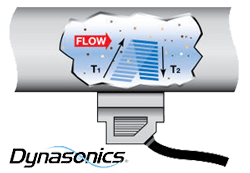
For clean liquids, the transit-time flow meter is the meter of choice. transit-time flow meters use two transducers which are typically mounted on the top of the pipe and spaced accordingly for the respective pipe diameter being measured. A sound wave traveling with the flow is transmitted in a V pattern from sensor A to the bottom of the pipe and back up to sensor B. It’s then sent in the opposite direction, this time against the flow, but in the same V pattern from sensor B to the bottom of the pipe and back up again to sensor A. Under normal flow conditions, the sonic wave traveling with the flow (A to B) will travel faster than the sonic wave traveling against the flow (B to A). Those “transit-times” are compared with each other and flow velocity is determined based on the difference in travel time.

Although the V pattern is the most commonly used, sensors can also be installed in a W pattern where the sound wave crosses the pipe four times traveling from sensor A to sensor B and Z pattern with the transducers mounted on opposite sides of the pipe. In this pattern, the sound waves only cross the piping one time traveling from sensor A to sensor B.
Because the sonic wave must travel unimpeded from one sensor to the other, the fluid must be clean and free of particulate, bubbles, etc.. If your fluid contains solids, particulate and/or bubbles, all is not lost. In this instance, consider using a doppler ultrasonic flow meter.
Doppler Flow Meters
Like transit-time meters, doppler flow meters measure flow from outside a pipe with a single clamp-on sensor. Rather than bouncing sound waves off on one another, the single continuously transmits high-frequency sound through the pipe wall and into the flow. As that signal strikes solids and/or gas bubbles in the flow path it is reflected back with an altered frequency which is proportionate to the flow velocity. Doppler flow meters continuously measure this frequency shift to calculate flow velocities and ultimately, flow rate and flow totals.
As opposed to Transit Time flow meters which cannot tolerate particulate in the flow, Doppler Flow Meters are dependent on solids and/or bubbles in the flow to operate correctly. They work well with fluids that would normally damage an invasive style meter. This includes slurries, wastewater, sludge, abrasive, and even corrosive fluids. With the sensor mounted on the outside of the pipe, there are is no pressure drop, there are no obstructions in the flow path and material compatibility is no longer a concern.
 Like most flow meters, ultrasonic meters work best when mounted using normal straight pipe requirements. Typically, that’s 15 to 20 pipe diameters of straight, unobstructed pipe upstream of the meter and roughly half that much on the downstream side.
Flow meters come in different styles, technologies, abilities, etc. No one meter that can do everything – but they all have their purpose. To learn more about flow meters contact our experts today!
How Cross Can Help
Cross Company Process Solutions is an authorized Solutions Partner, recognized Systems Integrator, Manufacturer’s Representative, and value-added Distributor for process manufacturers in a wide range of industries. With our focus on systems integration, process instrumentation, valves and valve repair, and many other full solutions, we can ensure your facility is running the way you need it to. Check out our products, services, and solutions to see how we can add value to your process.
As members of the Control System Integrators Association (CSIA) as well as certified solutions partners for ABB, Honeywell, Rockwell, Siemens, and VTScada, Cross Company has the the experience and expertise to optimize your process. Contact our Process Solutions Group today to learn more or to get started.