Waste water, often called process water, is a by-product within all chemical, refining, pharmaceutical, and food industries. EPA regulations mandate that all water returning to or interacting with the environment be safe and consistent with the water found naturally within the area.
Within the fracking industry, even though fracking water is being reused or recycled, compliance is critical because water is going back into the environment as part of the fracking process. The recovered water, or “fracking water”, is contaminated with well material and chemicals. Instead of harmful fracking water being placed into the environment, this water is filtered and pH balanced so that it can be reused for this application, or returned to the water table. Mixing with Eductors dramatically improves both the effectiveness and efficiency of processing fracking water.
The fracking industry has been under scrutiny due to the process in which injection wells are used and how it could potentially harm the environment if done improperly. The process is quite simple. First, clean water, sand, and other chemicals are injected into wells as far as 10,000 feet underground at high pressures causing the rock layers to crack and form fissures. These fissures are held open by sand particles that were injected, allowing oil or hydrocarbon liquids from the shale formation to flow up the well. Second, as the oil flows up and out of the well, the oil is collected in storage tanks and taken via truck to a pipeline. The fracking water is stored in pits until trucks take it to a treatment plant. This is where Eductor technology comes into play.
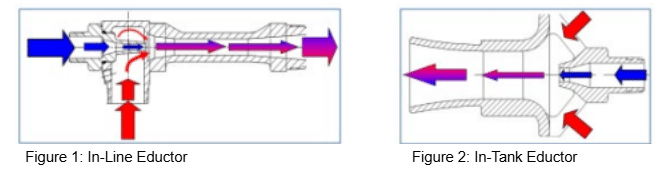
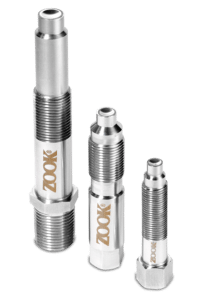
Both in-line and in-tank Eductors, shown in Figures 1 and 2, operate using the venturi principal. The motive fluid, blue arrow, passes through a venturi to create a pressure differential within the unit, promoting flow of a secondary fluid, the red arrow, toward the low-pressure area. The low-pressure fluid is “pumped”, or educted, into a process toward which it would not flow naturally.
When fracking water is received at a treatment plant, it must go through initial testing for solid content, pH, conductivity, specific gravity, etc. The treatment plant needs to know all this information to properly balance the pH, or neutralize, and filter the water to make it reusable. Treatment normally has four steps:
Step 1: Decanting – In the initial step, solids, which include metals and other organic material, settle to the bottom of the tank. The separated water then goes to another tank for the second step. The solids in the bottom of the tank are then removed and disposed of properly.
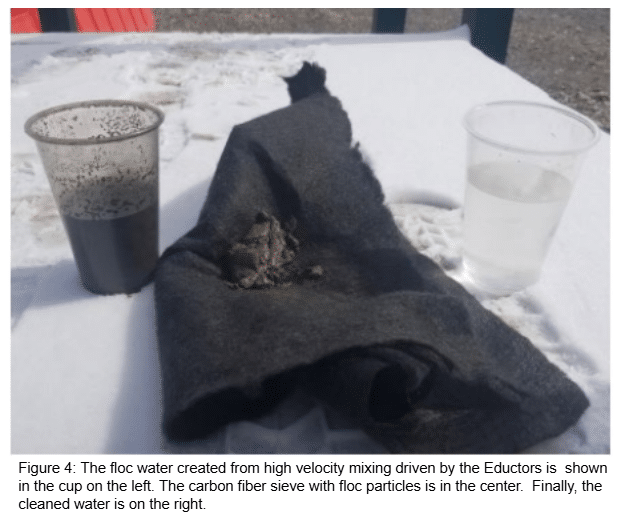
Step 2: Flocculation – The water from Step 1 goes into a flocculation stage where Eductor technology is applied. Chemicals are added to the tank. The Eductors mix the water and chemicals to promote the creation of solids. At the molecular level, the chemical that is injected causes a reaction in which certain molecules cause adhesion. This is where the particles, called colloids, form large size clusters known as “flocks”. The violent mixing of the Eductor creates a high velocity profile in the tank to promote these molecular interactions.
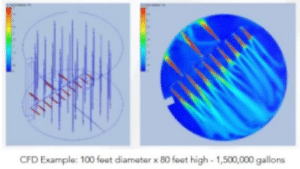
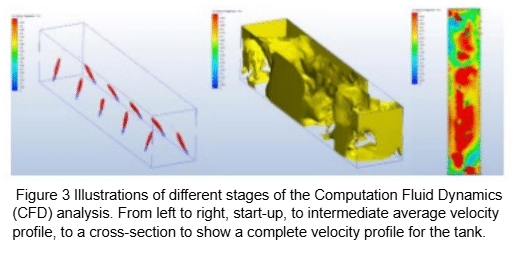
For the next portion of the process, our engineers create a digital model of the tank and the Eductors, as shown in Figure 3. These images represent a Computational Fluid Dynamics (CFD) analysis that was performed to determine the optimum placement of the Eductors in the tank. In this particular case, an optimal flow of 540 gpm at 30 psig was used. The average velocity in the tank, 0.6 feet per second, exceeded the net movement required to achieve the desired sheer for the flocculation process to be successful.
Step 3: Oxidation – The water from Step 2 is put into the oxidation tank where in-line Eductors are used to inject oxygen from the air into the water. This aerated liquid is piped to the bottom of the tank to help disburse the small bubbles throughout water. The bubbles create a larger surface area, thus making the rate of reaction from the injected chemical more effective. The air oxidizes the metals in the water, thus eliminating them through chemical oxidation.
Step 4: Filtration – The floc is mechanically separated through a carbon fiber sieve via gravity. The floc is then disposed of properly, leaving cleaned water to be reused for fracking, or safely returned to the water table.
Eductor technology for mixing and aeration greatly improved processing efficiency in this fracking water treatment application. In one case, a fracking waste water treatment facility treats and cleans eight to ten trucks of used fracking water per day. Prior to the installation of in-line Eductors, the same facility was only processing one to two trucks per day. The CFD analysis provided the facility data to verify the velocity in the tank along with confidence that this application of proven technology would work in this application.
In conclusion, Eductors have no moving parts and are maintenance-free, unlike mechanical mixers, and are far more effective. They can be optimally positioned in tanks of all shapes and sizes. In waste water and process water applications, in-tank and in-line Eductors will improve plant mixing and blending efficiency while decreasing the plant’s water footprint.