
We’re frequently asked how to select, maintain, and certify food and beverage grade hoses. To help specify the right hose for your application, we have put together this FAQ based on Parker’s PURE F&B hose offerings.
Q1. What makes a food-grade hose different from standard industrial hoses?
F&B grade hoses are specifically manufactured to preserve the quality of food products and prevent contamination. Unlike standard industrial lines, F&B hoses are tested for compound strength, their reaction to harsh cleaning/sanitary solvents, and their resistance to absorbing fats and oils. Their inner tubes are odorless and taste-free, ensuring they do not transfer any unwanted tastes or smells to the product being conveyed.
Q2. What’s the difference between Rubber and PVC hoses in food applications?
The material choice directly impacts performance based on the production environment:
- Rubber: Tougher and more rugged. It performs better at both high and low temperature extremes, handles higher pressure applications, has more flexibility, and delivers a longer service life in high use environments.
- PVC: Lighter weight but is more susceptible to kinking. It loses its structural integrity at high temperatures and becomes rigid when used in lower-temperature applications.
Q3. What factors dictate the overall flexibility of an F&B hose?
Hose flexibility varies based on plastic or rubber construction, material hardness, force-to-bend rating, wall thickness, size, and temperature parameters. Lower force-to-flex makes the hose assembly safer and easier for plant operators to handle manually. Selecting a corrugated cover gives more force-to-flex ratio and added structural flexibility over smooth finishes.
Q4. Which hoses work best in tight spaces around machinery?
If an application requires a hose to bend tightly around machinery, it runs the risk of collapsing or kinking. While highly flexible materials like silicone can address light kinking, heavy-duty suction and delivery applications incorporate an internal stainless steel or galvanized wire helix. This internal reinforcement acts as a rigid skeletal shell, preventing the hose from crushing or kinking under a vacuum or high bending stress.
Q5. What happens if I exceed the temperature or pressure rating of my hose?
Industrial safety and structural integrity rely on staying within factory parameters:
- Pressure Overload: Exceeding the max working pressure rating can lead to hose bursting, causing machinery damage, severe worker injury, and costly operational downtime.
- Temperature Overload: Operating a hose in conditions hotter than its rated range causes the underlying elastomers to melt or chemically break down. This degrades chemical compatibility and triggers premature hose failure.
Q6. What hoses are best for my distilling application?
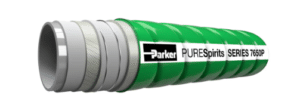 The Parker PURESpirits Series 7650P is an extra-flexible suction and delivery hose for spirits containing an alcohol concentration up to 99%.
- Technical Specifications: It features a phthalate-free, white Ultra-High-Molecular-Weight Polyethylene (UHMWPE) inner tube, textile plies with a galvanized helix wire reinforcement, and a green corrugated abrasion-resistant cover wrapped in an additional external thermoplastic helix. It handles 150 PSI across a temperature range of -31°F to +212°F.
Q7. Which hoses are best for applications with fatty or oily foods?
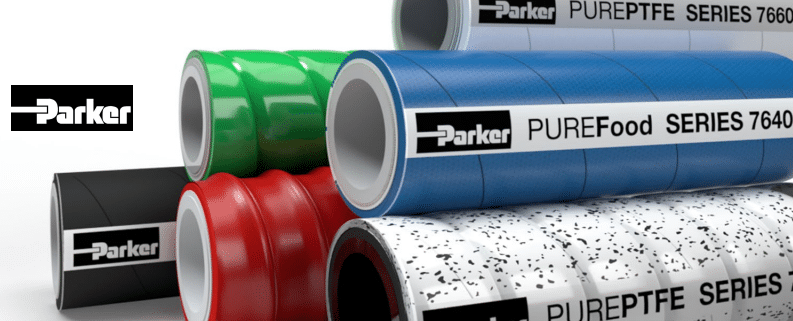
For applications involving dairy products, cooking oils, oily sauces, or dry abrasives, the Parker PUREFood Series 7640 and 7640P are recommended.
- Technical Specifications: These hoses utilize a white nitrile inner tube that is inherently resistant to fats and oils, keeping the tube from breaking down when transferring greasy mediums. They carry a working pressure rating of 150 PSI, a temperature range of -13°F to +176°F, and feature a blue EPDM cover (with the “Pro” version utilizing a corrugated UHMWPE protective outer layer).
Q8. Which hoses are best for our facility sanitation requirements and hot water washdown?
 The Parker PUREWash Series 7680 is a flexible, lightweight, medium-pressure washdown hose designed for hot water and mild cleaning chemicals within breweries, dairies, meat/poultry processing plants, and packing houses.
- Technical Specifications: It features an FDA-compliant white EPDM tube, multiple textile plies, and a smooth white or blue EPDM cover that is UV and ozone resistant. It is rated for 300 PSI and operates across a temperature spectrum of -40°F to +212°F.
Q9. Why are internal expansion fittings better for F&B applications compared to traditional crimped fittings?
This choice changes the interior profile and behavior of the hose wall:
- Crimp Fitting: This method is ideal for both hard-wall and soft-wall hoses. A properly compressed outer crimp wall compresses the hose material inward; while the internal wire helix resists collapsing, this compression can cause minor structural disruptions to the inner hose wall.
- Internal Expansion: Best suited for soft-wall hoses. The insertion is expanded outward against the hose wall from the inside, causing virtually zero disruption to the smooth interior profile and eliminating potential bacterial trap zones. The hose’s internal wire helix acts as a shell to hold the seal.
Q10. Can the material of a hose have an impact on my plant’s fire prevention and employee safety?
When F&B applications involve high processing temperatures or electrical currents, you must evaluate material flammability. Depending on the elastomer or polymer chosen, a hose exposed to fire may emit hazardous toxic fumes, self-extinguish, or maintain non-flammable characteristics. Selecting a hose compound with high impact strength and a low coefficient of friction helps prevent external cover tearing and snagging, adding an extra layer of protection for plant employees.
Q11. Does it matter how heavy the hose is for my application?
Evaluating the total combined weight of your flexible tubing, reinforcing wire helix, and chosen fitting end-connections is essential during system integration. If a hose assembly is excessively heavy, its hanging weight can create continuous downward leverage and pulling forces on neighboring equipment, jeopardizing the integrity of the fitting connections and risking premature leaks.
Q12. What global regulatory and cleanliness standards do Parker PURE F&B hoses comply with?
Parker PURE series hoses are engineered from non-toxic, phthalate-free compounds produced on stainless steel mandrels to ensure compliance across a suite of strict international standards and regulatory bodies, including:
- FDA (Food and Drug Administration)
- GMP (Good Manufacturing Practices)
- USDA (United States Department of Agriculture)
- 3A Sanitary Standards
- NSF International & ISO 9001:2015
- USP Class VI (United States Pharmacopeia)
- EU Regulations (including CE, REACH, and EC 1935/2004)
Q13. Why should a facility prioritize Good Manufacturing Practice (GMP) Certified food-grade hoses?
Using a GMP-certified hose ensures strict factory cleanliness, with traceable material made in an audited quality system. GMP certification guarantees that the entire hose construction meets FDA requirements for materials, not just the inner tube. This prevents any individual layer of the hose from migrating or containing substances that could leach into your food media, ensuring the product will not absorb media or extract non-permissible substances.
Q14. Which Parker hose series are GMP Certified?
Parker offers several specific series depending on the tube’s core compound:
- Butyl Tubes: PUREBev Series 7630, 7630P, 7630PL, and PUREBev CR Series 7631 and 7632.
- UHMWPE Tubes: PURESpirits Series 7650P.
- PTFE Tubes: PUREPTFE Series 7660 and 7660P. (Note: The Nitrile-tube PUREFood Series 7640 and 7640P are engineered to meet strict food-grade standards and are slated for upcoming certification).
Partner with the Experts at Cross Hose and Fittings
Selecting the right sanitary transfer line involves balancing strict regulatory compliance with challenging plant environments. Don’t guess when it comes to your fluid conveyance safety, hygiene, and efficiency.
Cross Hose and Fittings can help you navigate complex technical specifications—from evaluating force-to-flex parameters and internal wire helix structural integrity to mapping out complete factory traceability requirements. Speak with a Hose and Fittings expert today to optimize your manufacturing process, eliminate contamination risks, and spec the exact Parker PURE hose for your specific application.