In plastic and rubber extrusion, pressure is everything. It’s what allows polymer melt to be shaped, controlled, and delivered with precision. But when pressure moves outside its normal operating window, whether due to a blocked die, a screen pack issue, material inconsistency, or a downstream restriction, the results can be expensive at best and dangerous at worst.
This is where extrusion burst plugs and rupture disks play a critical role. These pressure relief devices are often small, simple components, but they serve as the last line of defense against equipment damage, unplanned downtime, and serious safety incidents.
At ZOOK, we’ve spent decades working alongside extrusion processors and OEMs to engineer rupture disks and extrusion burst plugs that perform reliably in high-pressure, high-temperature melt environments. In this blog, we’ll walk through how they work, why their design matters, and the most common FAQs processors ask when specifying pressure relief devices for extrusion.
Understanding Overpressure in Extrusion
Extrusion processes routinely operate at high pressures, often in the 1,000 to 15,000 psi range, depending on the polymer, screw design, and downstream equipment. Under normal conditions, these pressures are stable and predictable. Problems arise when something disrupts melt flow.
Common causes of overpressure in extrusion include:
- Die restriction or blockage
- Screen pack fouling or screen changer events
- Frozen, un-melted, or degraded material
- Melt pump issues
- Unexpected contamination or viscosity swings
When pressure spikes occur, the weakest component in the system will fail, unless a properly selected extruder rupture disk (extrusion burst plug) is installed to relieve pressure in a controlled and predictable way.
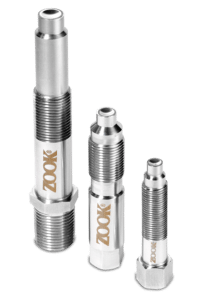 What Is an Extrusion Burst Plug?
An extrusion burst plug, also commonly referred to as an extruder rupture disk, burst disk, or rupture disc, is a non-reclosing pressure relief device designed specifically for polymer melt service. Each ZOOK extrusion burst plug assembly consists of a threaded tubular body with a rupture disk welded onto the process end.
Extrusion burst plugs are mounted directly into the extruder through a pressure port or thermocouple well where critical pressures are experienced, making them a straightforward, engineered safety component for the melt stream.
When system pressure exceeds the predetermined burst pressure, the disk ruptures instantly, venting material and preventing damage to the extruder barrel, die, melt pump, or other downstream components.
Unlike pressure relief valves, extrusion burst plugs:
- Have no moving parts
- Require no calibration or routine maintenance
- React immediately to pressure spikes
- Have no recesses where product can collect and solidify
- Must be replaced after activation (single use by design)
Read the full resource