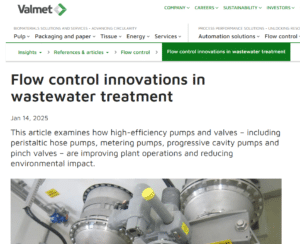
 Wastewater treatment facilities face increasingly complex challenges in managing diverse chemical processes, ensuring environmental compliance and optimising operational efficiency. As the industry evolves to meet stricter regulations and sustainability goals, the demand for sophisticated flow control equipment has grown. This article explores recent developments in flow control technology for wastewater treatment, including contributions from companies such as Valmet.
Wastewater treatment involves multiple stages: preliminary treatment, primary sedimentation, secondary biological treatment, and tertiary filtration and disinfection. Throughout these stages, various chemicals are used, including pH neutralizers, anti-foaming agents, coagulants, flocculants and disinfectants. Each chemical presents unique challenges in terms of pH levels, viscosity and material compatibility. Controlled chemical dosing is crucial for efficient treatment. Optimal dosing improves performance, reduces costs and minimises environmental impact. Key requirements include adjustable dosing based on real-time monitoring, accuracy, chemical compatibility and reliability in harsh environments.
Precise chemical dosing
Accurate chemical dosing is crucial in wastewater treatment. Excessive dosing can lead to unnecessary chemical costs and potential environmental issues, while insufficient dosing may result in ineffective treatment. Key factors in optimal dosing include:
- Adjustability based on influent quality and flow rate
- High accuracy across various flow rates
- Chemical compatibility to prevent equipment degradation
- Reliability in corrosive environments
Advanced flow control solutions must address these factors to ensure efficient, cost-effective and environmentally sound wastewater treatment.