What Type of Torque Do I Need?
With a vast array of torque products for nearly unlimited applications, it can be challenging to find the equipment that is right for your needs. Our experts have years of experience working with all types of torque equipment and can explain some of the key differences in the most common items. More importantly they have first hand knowledge of which items are best used in different settings to help you find the product that may be best for your needs.
Click-Type Torque Wrenches
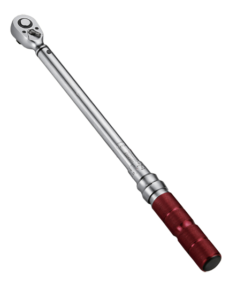 These are one of the most common types of torque products on the market. So common in fact, that unlike most of the other torque products in this article, some versions can even be picked up at your local hardware store. This is because the click type torque wrench is frequently used around the garage to tighten fasteners such as nuts and bolts on vehicles and other equipment.
The simple design of most click type torque wrenches includes a ratcheting head, adjacent to a pivot block (or pivot point) with an adjustment spring in the handle. The combination of these mechanisms allows the user to set the torque wrench to click at a given setting on a scale. Most can click in clockwise or counter clockwise settings. Of course there are many different designs by numerous manufacturers which range from very small torque values such as 15-30 lbf-in all the way to values such as 600 lbf-ft.
When shopping for a click type torque wrench for industrial applications such as manufacturing, or aircraft repair, etc. a higher quality product is recommended that will hold up to frequent repetition. This ensures longer equipment life. Routine calibration and maintenance are necessary to ensure optimal performance for click type wrenches. Most wrenches can easily be taken apart and maintained by a trained professional. Cross has the capability to perform maintenance on torque wrenches from most brands in the industry.
Pneumatic Torque Wrenches/Drivers
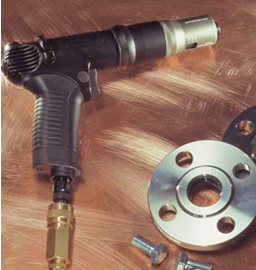 Another common type of torque equipment is the pneumatic torque wrench. These are frequently used in production facilities, where speed and efficiency are desired while fully tightening fasteners in many areas.
The key difference between these and any other type of torque product is a driver type rotation allowing the equipment to fully tighten a fastener. As opposed to a wrench which just torques a nut or bolt after it has already been in place, a pneumatic torque driver has the capability to tighten a fastener from start to finish. One of the most recognizable uses for pneumatic torque guns is in racing, where pit crews change out tires on vehicles in record speeds. This same concept can be found in automobile plants throughout the world.
When shopping for a pneumatic torque driver, note that the end user adjustment on most models can be limited. Most pneumatic wrenches seen in our laboratories have a variable-single setting, meaning a desirable torque value is set upon calibration and end user adjustment is limited. This is mostly beneficial in high volume scenarios where the same torque is required for all fasteners.
Torque Screwdrivers
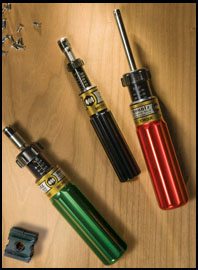 The torque screwdriver is used at low torque values where accuracy and uniformity is desired. Many medical device manufacturers and electronics manufacturers use these to maintain consistent torque values on small nuts/bolts and screws that are hand fastened.
Some torque screwdrivers are made to be end user adjustable, but as with pneumatic torque guns, a large amount of the models we see in our laboratories are variable single-setting screwdrivers. Cross works with most brands in the industry and torque screwdriver calibration and repair on a variety of models.
Torque Multipliers
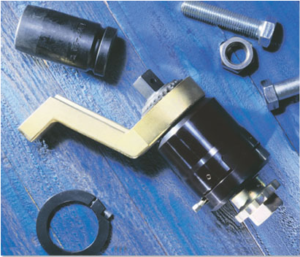 Torque multipliers are used in scenarios where very high torque values need to be achieved without the use of a “cheater bar” or extended handle. The idea is to reduce the leverage needed to attain those values. They work by a series of internal gears which multiply the actual force applied. Much safer than using extended leverage (in the case of a catastrophic failure), a torque multiplier is typically used in tight spaces where the use of extended leverage isn’t an option.
Torque multiplier calibration and maintenance is fairly straight forward. It is best practice to calibrate a torque multiplier on a regular basis, so problems can be discovered fairly quickly. With access to the correct replacement parts, our technicians are usually able to open most models of torque multipliers and change out internal components for a relatively quick and inexpensive repair.
Torque Analyzers
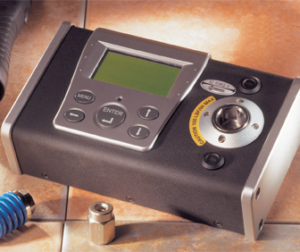 Calibrated torque analyzers are imperative to keeping a variety of torque equipment calibrated and verified. Whether it is a click type torque wrench, a pneumatic torque gun, a torque watch, or all of the above, torque analyzers are set up to perform torque checks when you need them most. Each unit typically has multiple torque transducers to span the range of very small torque values to very high torque values. Cross has the capability to perform torque transducer calibration ranging from the smallest all the way up to 2000 lb-ft in select service centers.
Torque Meters/Dial Torque Wrenches
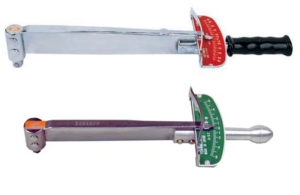 These can be less accurate than benchtop torque analyzers since they often rely on visual interpretation, but can be used in settings where an operator is searching for applied torque values where a full scale torque analyzer won’t work. They can be electronic or mechanical with either a sensor or a flexible bar indicator showing the torque value on a visual scale or with lights or sound.
Torque Watches
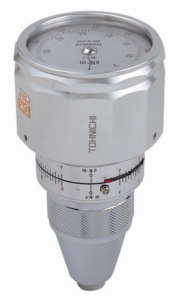 Torque watches are similar to torque meters and most frequently cover the very low end of the torque scale. Hand held units are frequently used to test torque values in small electronic equipment, medical devices, and other applications where very low torque readings need to be verified.
Due to the sensitivity of torque watches, most maintenance should be performed by a certified technician with the correct testing equipment. Cross works closely with torque watch manufacturers to ensure any calibration or maintenance is performed correctly.
Calibrating Your Torque Equipment
It is important, with whatever type of torque product you use to have your equipment checked or calibrated based on the frequency used. Over time, internal parts can wear, equipment can get dropped or damaged, and torque output can change without you knowing. Cross offers quality torque equipment calibration and can quickly check all types of torque products to provide a detailed report through Gagesuite™. We are he to make sure you know exactly what torque output your equipment is producing at all scale levels. Do you have any of the torque equipment noted in this article? If so, please contact Cross for service!