Standard vs. Accredited Calibration

The Difference Between Standard Calibration and Accredited Calibration

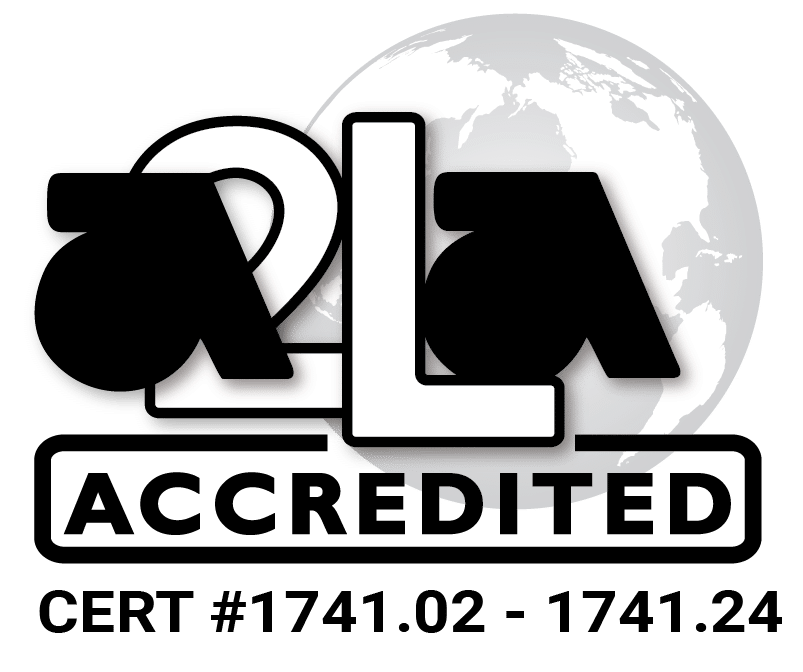
We frequently field questions about the difference between a standard calibration and an accredited calibration. For the laboratories at Cross, an accredited calibration follows a process that has been accredited by A2LA and conforms to the standards set by ISO 17025. Although all customers benefit from our stringent quality system and ISO 17025 accreditation, all accredited calibrations must meet additional, specific requirements identified by A2LA (our accrediting body).

Some of these additional requirements involve additional information on the calibration certificate. These include the presence of the accreditation logo and our lab’s certificate number as well as measurement uncertainties listed for each test point. This evaluates the repeatability of the specific device under test and gives our customers more useful information for determining their measurement accuracies than a stated measurement accuracy ratio.

However, a few of the differences between a standard and accredited calibration have to do with what happens “behind the certificate”. For example, during an accredited calibration the technician evaluates the repeatability of the specific device under test by calculating the actual uncertainty for each test point. Also, for an accredited calibration the Cross technician must follow the exact calibration procedure listed on our scope, such as ASTM D2240 for durometers, even when other procedures exist. Finally, in order to maintain our accreditation we participate in blind, inter-laboratory proficiency testing to verify our measurement capabilities and stated uncertainties. Learn more about our accredited calibration and get a quote for service today!


Why Partner With Cross Company?

In the field of metrology, there are many standards to follow to ensure reliable calibration or inspection. At Cross Precision Measurement, we are an ISO 17025 accredited calibration laboratory that adheres to standards set out by NIST (HB44), the National Conference on Weights and Measures (NCWM), the National Type Evaluation Program (NTEP), A2LA, and other relevant standards. With our experience and expertise, we can ensure you’re getting reliable, repeatable metrology results.

Since 1939, our Precision Measurement group has provided industry-leading technical expertise coupled with world-class customer service to manufacturing and other industrial operations in need of onsite calibration, product inspection, precision measurement equipment, and more. Our precision measurement and inspection teams have the knowledge and resources to help you reduce risk, improve quality, and increase efficiency throughout your entire process. With our extensive network of calibration labs across the Southeast and Midwest, we can ensure you’re getting the metrology services you need. Contact Cross Precision Measurement today

Latest Cross Company Resources

System integrators must test control system configurations. Ideally we thoroughly test them before systems are delivered. Simulating inputs based on outputs is a key tool to perform these tests.
July 28, 2026
Author – Chris Hardy
Cross Logo
A global leader in food ingredients provides micro-ingredient feeders to flour and corn mills to facilitate the addition of enrichments, bleaching products, and other additives. To address increasing customer requirements for precision and data logging, the manufacturer partnered with Cross to modernize these systems by retrofitting established hardware with advanced
June 30, 2026
Cross Logo
production line using servo drive automation
Maximize efficiency and precision in your automation processes. Learn how to optimize your motion control systems with Applied Motion Products from Cross Company.
June 16, 2026
Cross Logo
Stop patching and start planning. Learn how a phased 6-step roadmap for legacy control system modernization reduces risk, spreads costs, and avoids downtime.
April 9, 2026
Cross Logo
katronic logo
Learn how Cross Process Solutions utilized the KATflow 150 to solve water billing inaccuracies and identify steam leaks for a major manufacturer. Discover the advantages of non-invasive ultrasonic technology for continuous industrial processes where system downtime is not an option.
February 9, 2026
Cross Logo
katronic logo
Cross Company helped a major automotive manufacturing facility in Alabama improve their operation by replacing legacy ultrasonic flow meters. Learn More!
February 5, 2026
Cross Logo

See how our team can help improve efficiency, reduce risk, and raise quality in your process.

Share This Material

Contact our Team

"*" indicates required fields

This field is for validation purposes and should be left unchanged.
What can we help you with today?*

Where Can We Send Your Information?

Name*
Company Location*
This field is hidden when viewing the form
Form Type
This field is hidden when viewing the form

Hang Tight! We're Searching... Searching... Searching...

We’re looking through thousands of pages to find the most relevant information.

In the meantime, enjoy these fun facts…

Did you know… Cross Company is an ESOP (Employee Stock Ownership Plan). Our ESOP started in 1979 and as of 2006, we are 100% employee-owned! Learn more about our ESOP and how that benefits both team members and our customers.
Did you know... the precision measurement group at Cross was founded in 1939 by our current CEO's grandfather, Jim King. That's a whole lot of calibration!
Did you know... A fingerprint weighs about 50 micrograms. We know, we weighed it! The residue left from a finger can actually make a difference in weight results which is why we wear gloves when we calibrate weights. For reference, a sheet of paper is about 4.5 grams, that’s 4.5 million micrograms.
Did you know… Cross Company has grown significantly since our start in 1954. Over the years we've acquired 26 companies! Today, our five groups have expertise in everything from industrial automation to precision measurement, and industry knowledge going all the way back to 1939.