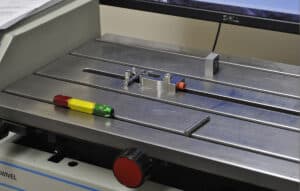
 In high-volume manufacturing, speed and repeatability are just as important as accuracy. While digital calipers and micrometers provide variable data (the exact measurement), they can be slow and prone to operator error during rapid inspections. This is where Go/No-Go gages, also known as fixed limit gages, become essential.
A Go/No-Go gage is a precision tool used to verify that a part feature stays within its specified upper and lower limit. Before you invest in a new set of gages for your quality lab or shop floor, there are several technical factors to consider to ensure your measurement system remains valid.
Understanding the Go/No-Go Principle
The fundamental logic of these gages is based on the “Maximum Material Condition” (MMC) and the “Least Material Condition” (LMC).
- The “Go” Member: This gage checks the Maximum Material Condition. For a hole, the “Go” member is the smallest allowable diameter. It must be able to pass through the entire length of the feature without force.
- The “No-Go” Member: This gage checks the Least Material Condition. For a hole, this is the largest allowable diameter. If the “No-Go” member enters the part, the part is oversized and must be rejected.
By using this binary method, operators can inspect parts in seconds without needing to interpret a dial or digital readout.
Choosing the Right Type of Gage
Selecting the correct gage geometry is the first step in the procurement process. The most common types include:
- Plug Gages: Used for inspecting internal diameters (holes). These are often “double-ended,” with the Go and No-Go members attached to a single handle.
- Ring Gages: Used for inspecting the outside diameter (OD) of shafts or cylinders.
- Thread Gages: Available as both plugs and rings, these verify the pitch diameter and lead of threaded features.
- Pin Gages: Typically used for checking small hole sizes or the distance between holes. They are usually sold in sets (Class ZZ) for general shop use.
- Snap Gages: A C-shaped gage used to quickly check outside diameters or thicknesses while the part is still in the machine.
Material Selection and Durability
The material of your gage directly impacts its “wear life.” Since Go/No-Go gages rely on physical contact, they will eventually wear down.
- Tool Steel: The industry standard. Usually hardened to Rc 60-62. It is cost-effective but susceptible to rust if not properly oiled.
- Chrome Plated: Provides a harder surface and superior corrosion resistance. Chrome is excellent for high-volume lines as it extends the life of the gage.
- Carbide: The premium choice for extreme wear resistance. While more brittle and expensive, carbide gages can last up to 10 to 50 times longer than steel in abrasive environments.
Understanding Gage Maker’s Tolerance (The 10% Rule)
One of the most common mistakes in purchasing gages is failing to account for the gage’s own manufacturing tolerance. In metrology, we follow the 10% Rule.
Ideally, the tolerance of the gage should only consume 10% of the part’s total tolerance. For example, if you are checking a hole with a tolerance of 0.001 in, your gage should have a tolerance of 0.0001 in.
Gages are classified by their accuracy levels:
- Class XX: Extremely high precision (often used for master gages).
- Class X: The standard for most quality lab inspections.
- Class Y & Z: Common for shop floor requirements.
- Class ZZ: Typical for pin gage sets with wider tolerances.
Calibration and Environmental Stability
A gage is only accurate if its dimensions are traceable to a national standard (such as NIST). When purchasing, ensure the gage includes a Long Form Certificate of Calibration that lists the actual values found during its final inspection.
Furthermore, remember that steel expands and contracts with temperature. The industry standard is to calibrate high precision gages in an environment held at 68°F (20°C). If your shop floor is 90°F, your gage and your part may expand at different rates, leading to “false rejects” or, worse, “false accepts.” Something to keep in mind is the temperature listed on the calibration certificate, versus any extreme manufacturing conditions. Take a look at our video about The Thermal Coefficient of Expansion & Why It Matters.
Summary Checklist
Before placing an order, verify these five criteria:
- Gage Type: Does the geometry match the feature (e.g., Thread Plug vs. Plain Plug)?
- Tolerance Class: Does the gage tolerance follow the 10% rule for your part specification?
- Material: Is the material suited for the volume (Steel for low volume, Carbide for high)?
- Go/No-Go Logic: Are the members clearly marked (usually a green ring for Go and red for No-Go)?
- Certification: Does the supplier provide ISO 17025 accredited calibration data?
How Partnering With Cross Benefits Your Operation
When it comes to metrology and calibration to ensure continuing accuracy, many industrial operations find it difficult to stay on top of everything internally. That’s where Cross Company comes in. At Cross Precision Measurement, we provide industry-leading dimensional calibration services, on-site or in-lab inspection services, metrology equipment repair, and equipment for operations who rely on accurate measurements.
Whether you’re an industrial manufacturer, commercial operation, or even a lab, Cross can help. Our network of ISO 17025 accredited calibration laboratories adhere to standards set by A2LA, NTEP, NCWM, and NIST (specifically, HB44) to ensure consistent quality and accuracy. Our goal is to make sure you’re getting accurate, reliable measurements every time. Contact Cross Precision Measurement today to get started or to talk with our experts about your next project.