Pneumatic Cylinder Air Flow Requirements

How much air flow is required to power a pneumatic cylinder?

We frequently get the same pneumatic cylinder question from customers: How much air flow is required to power a pneumatic cylinder?

This is critical to ensure that the pneumatic cylinder is supplied with enough air flow to operate as it is intended in your system design. This calculation does depend on the type of cylinder you are using, particularly whether it is a single-acting cylinder or a double-acting cylinder.


Pneumatic Cylinder Information

First, we must gather some basic information about your pneumatic cylinder so we can calculate the air consumption:

Piston Area (Bore x 3.1415)
Rod Area (for double-acting cylinders)
Stroke
Cycles per minute


Air Flow Required for Single-Acting Cylinder

Calculating the air consumption for a single-acting cylinder is a rather easy calculation, but it is important to understand that the required air flow is dependent not only on the bore area and stroke, but also the cycle rate of the pneumatic cylinder.
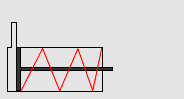
Pneumatic Cylinder Air Flow Requirements 1The formula for the air consumption of a single-acting cylinder is as follows:

A = Piston Area (Square Inches)
S = Stroke (Inches)
C = Cycles per Minute
CFM (Cubic Feet per Minute) = (A x S x C) / 1728

Keep in mind that dwell times and cylinder sequence can affect the results when using this formula.


Air Flow Required for Double-Acting Cylinder

In a double-acting cylinder, the retracting volume and extending volume differ by the displacement of the rod.
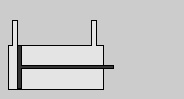
Pneumatic Cylinder Air Flow Requirements 2The formula for the air consumption of a single-acting cylinder is as follows:

A = Piston Area (Square Inches)
S = Stroke (Inches)
C = Cycles per Minute
CFM (Cubic Feet per Minute) = (A x S x C) / 1728

Keep in mind that dwell times and cylinder sequence can affect the results when using this formula.

In certain applications, the double-acting cylinder may be required to extend and retract at a different rate. Obviously, this changes our calculation of the air consumption.

In this situation, the air consumption of each stroke must be calculated separately as follows:

EC = Extend cycles per minute (ignoring dwell time)
RC = Retract cycles per minute (ignoring dwell time)
CFM = (A x S x EC) / 1728 + [(A – R) x S x RC] / 1728


Converting CFM to SCFM

Converting the flow rate from CFM (compressed air) to SCFM (free air) can be calculated as follows:

P = Pressure (PSIG)
SCFM = CFM x (P + 14.7) / 14.7

Knowing how to use these calculations help with the sizing of the system components as well as calculation of the total air consumption of the system. Interested in learning more? Contact a Cross pneumatic expert for more information or to see how Cross can help your operation!

Latest Cross Company Resources

An animal healthcare leader in Durham, North Carolina, recently faced a critical threat to its production operations. Vendor-driven equipment obsolescence and sudden price spikes threatened output, forcing the team to find a viable alternative to maintain their critical processes.
January 12, 2026
Cross Logo
This automated palletizing cell improves stack consistency, reduces labor, and lowers the risk of injury. Watch the video to see how! CrossCo Automation.
October 2, 2025
Cross Logo
Dr. Daniel Moore is an Assistant Professor in the Ophthalmology and Visual Sciences Department at a major research university. He specializes in glaucoma, an eye disease which is due to several different factors.
September 30, 2025
Cross Logo
Pallet of Boxes
Historically, Lindy’s relied on small thermometers mounted on support columns to keep track of the temperature in their cold storage. Several times a day, someone had to walk around the refrigerated warehouse, collecting data by hand and then manually entering the information into the company’s quality system. Not only was
September 30, 2025
Cross Logo
KapStone Paper and Packaging makes unbleached kraft paper and high performance lightweight liner board. Their Roanoke Rapids, North Carolina plant, set on the banks of the Roanoke River, runs 24/7 with approximately 430 employees producing over 470,000 tons of paper per year. The Fiber Supply department works with local vendors
September 30, 2025
Cross Logo
Sutherland Products is a boutique manufacturer of commercial and household cleaning products located in Mayodan, North Carolina. The company is best known for its Charlie’s Soap brand of laundry detergents and cleaning products, which combine effective cleaning and low environmental impact. From its origins in the Piedmont Triad area, the
September 30, 2025
Cross Logo

See how our team can help improve efficiency, reduce risk, and raise quality in your process.

Share This Material

Join Our List for More!

Want to get content like this delivered to your inbox? Subscribe today! Don’t worry, it’s completely free, and the information our experts put together is actually pretty nice to have in your inbox. Just drop your email and the industry that best describes your operation.

Contact our Team

Hang Tight! We're Searching... Searching... Searching...

We’re looking through thousands of pages to find the most relevant information.

In the meantime, enjoy these fun facts…

Did you know… Cross Company is an ESOP (Employee Stock Ownership Plan). Our ESOP started in 1979 and as of 2006, we are 100% employee-owned! Learn more about our ESOP and how that benefits both team members and our customers.
Did you know... the precision measurement group at Cross was founded in 1939 by our current CEO's grandfather, Jim King. That's a whole lot of calibration!
Did you know... A fingerprint weighs about 50 micrograms. We know, we weighed it! The residue left from a finger can actually make a difference in weight results which is why we wear gloves when we calibrate weights. For reference, a sheet of paper is about 4.5 grams, that’s 4.5 million micrograms.
Did you know… Cross Company has grown significantly since our start in 1954. Over the years we've acquired 26 companies! Today, our five groups have expertise in everything from industrial automation to precision measurement, and industry knowledge going all the way back to 1939.