Application Note: Cross Reservoir Optimization

Learn how we helped a customer shrink their hydraulic reservoir by 63% with no loss in performance

As a mobile machine integrator for the past fifty years, we’re very familiar with the idea of “ if it isn’t broken, don’t fix it,” meaning that if the design of a machine is good enough, there is no need to improve. This is the case for hydraulic reservoirs, where many companies are still using legacy designs. A common rule of thumb when it came to sizing was 2:1, twice the amount of flow, to allow for dwell time and de-aeration. With the focus on having enough fluid capacity, efficiency wasn’t a primary concern, resulting in tanks that were frequently bigger and heavier than they needed to be.

OEMs today, however, are under extreme pressure to produce machines which are more efficient to manufacture and more efficient to run. And the size of the hydraulic reservoir is one area which is frequently overlooked but can yield significant savings. Cross partner Schroeder Industries has invested in simulation software and CFD analyses to provide data on tank dynamics and characteristics to uncover inefficiencies in the tank assembly.

Using this data, Cross works with our customers to optimize their reservoir size and design which can reduce the size of the tank needed. A smaller tank leads to:

  • Improved machine energy efficiency due to overall weight reduction and reducing the warm up time needed
  • Reduced oil consumption over the lifetime of the machine, from initial fill to repeated customer use
  • Reduced initial manufacturing cost by using a tank with less material
  • Increased space on the machine which can be used for either new/improved components or for increased payload
  • Improved pump inlet conditions by reducing aeration and turbulence
Application Note: Cross Reservoir Optimization 1

Reservoir analysis looks at four areas:

  1. Volume optimization: Identifies dead zones where fluid stagnates and is not effectively used by the system
  2. Fluid velocity: A lower fluid velocity helps keep oil de-aerated and prevents new air from entering the fluid due to sloshing and turbulence.
  3. Temperature: Mapping can show how quickly and evenly the fluid reaches operating temperature and identifies hot spots which could lead to fluid degradation
  4. Structural: Not only do we examine how the fluid circulates, but we look at whether the reservoir will deflect or fail when full or be damaged when mounted or load bearing.

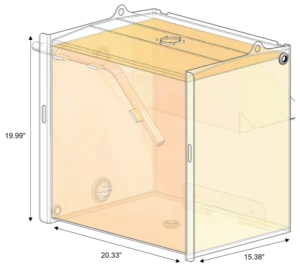
Below is a recent example of analysis that Schroeder and Cross did for a Cross customer manufacturing utility trailers. Their existing reservoir uses Mobile Fluid 424 at a nominal operating temperature of 70℉ with a volume of 24.44 gallons, a 0.56 gallon drawdown.
Application Note: Cross Reservoir Optimization 2

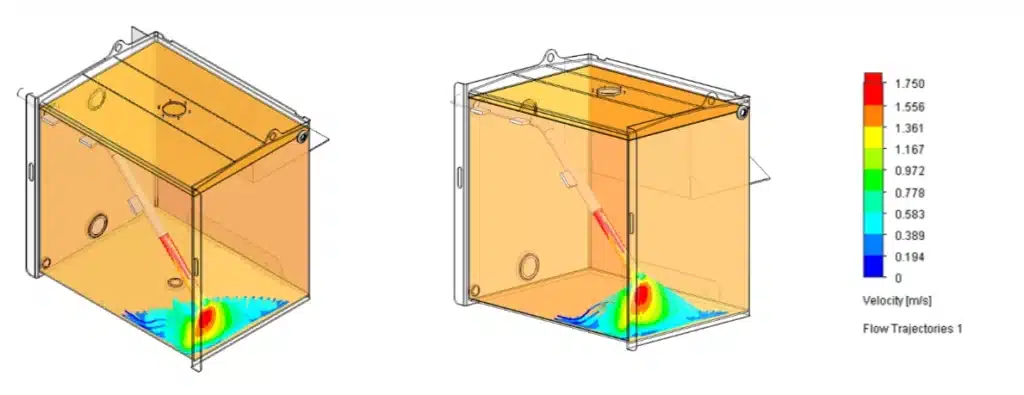
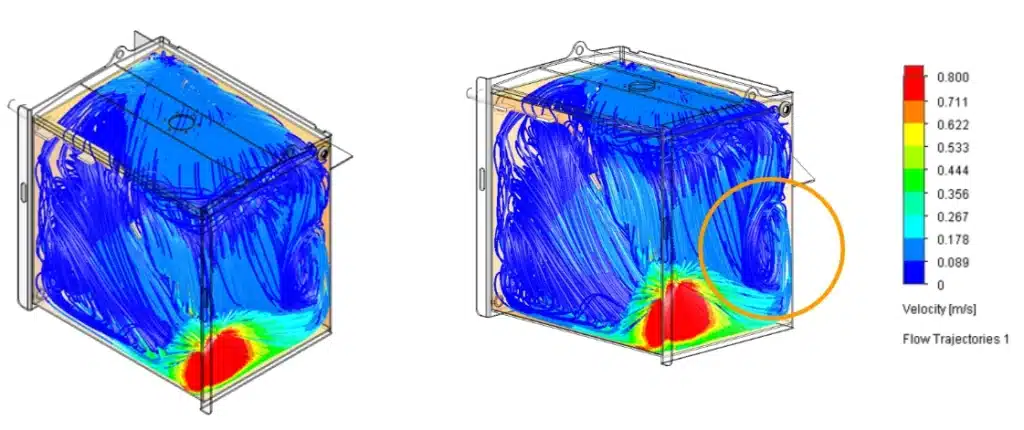
The turbulence created by the downpipe can be seen in the red circular areas above and below. This returning flow could be handled in a way that maintains significantly smoother and more laminar flow paths. This is the ultimate goal of tank optimization – to minimize turbulence and abrupt changes in flow paths.
Application Note: Cross Reservoir Optimization 3

Application Note: Cross Reservoir Optimization 4Schroeder also tested both surface velocities and de-aeration performance and both were found to be within acceptable limits.

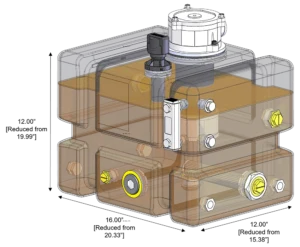
With all this data in hand, the recommendation to our customer was to consider a smaller tank with a Schroeder MTB return filter with diffuser to reduce the velocity of flow into the tank. The TNK7 from Schroeder spec’d below was 6.44 gallons, with the same 0.56 gallon drawdown.




Latest Cross Company Resources

Technimark, a manufacturer of high-value injection-molded packaging and components, works with some of the most recognizable brands to create rigid plastic solutions for healthcare, consumer packaging, and even industrial applications. The team at Technimark partners with their customers to take designs from the idea stage, through engineering, production, and finally
September 30, 2025
Cross Logo
roanoke va
Our customer is a specialized manufacturer of machinery for processing metal coils and grinding rolls based in Roanoke, Va. They needed to integrate a new inspection station into their existing production line. The challenges were to design a system that could accommodate their existing gantry, all while holding and inspecting
September 17, 2025
Cross Logo
An automotive manufacturer requiring a high level of alignment in their ring gears requested an easy to use 360 degree measuring tool that could quickly determine the total runout along the circumference of the gear. Prior to using the solution from Cross the part was manually rotated on a stand
September 11, 2025
Cross Logo
small parts packaging system
A munitions manufacturer wanted to improve their finished goods product packaging, ensuring the correct count of bullets were being packaged into their bulk boxes. Prior to adopting a small parts counting control system from Cross they manually counted bullets into the boxes, and to verify the counts were correct they
September 11, 2025
Cross Logo
A water treatment chemical manufacturer needing to blend high concentrate sulfuric acid into multiple blending stations requested a solution to measure and batch the acid introduced into the mixture. Holding the acid supply in a nearby isolated environment required a system to safely transport and batch the acid to the
September 11, 2025
Cross Logo
A small engine appliances manufacturer requested a solution to calibrate their engine safety testing system. The particular testing system utilizes a dynamometer, laser tachometer and timer all connected in a PLC to determine the time needed for a lawnmower blade to come to a complete stop after the emergency switch
September 11, 2025
Cross Logo

See how our automation team can help improve quality, increase efficiency, and reduce risk.

Share This Material

Contact our Team

Hang Tight! We're Searching... Searching... Searching...

We’re looking through thousands of pages to find the most relevant information.

In the meantime, enjoy these fun facts…

Did you know… Cross Company is an ESOP (Employee Stock Ownership Plan). Our ESOP started in 1979 and as of 2006, we are 100% employee-owned! Learn more about our ESOP and how that benefits both team members and our customers.
Did you know... the precision measurement group at Cross was founded in 1939 by our current CEO's grandfather, Jim King. That's a whole lot of calibration!
Did you know... A fingerprint weighs about 50 micrograms. We know, we weighed it! The residue left from a finger can actually make a difference in weight results which is why we wear gloves when we calibrate weights. For reference, a sheet of paper is about 4.5 grams, that’s 4.5 million micrograms.
Did you know… Cross Company has grown significantly since our start in 1954. Over the years we've acquired 26 companies! Today, our five groups have expertise in everything from industrial automation to precision measurement, and industry knowledge going all the way back to 1939.