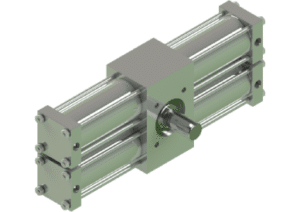
Rotomation Application: Options for Actuators in Harsh Environments

Supplier Resource

Actuators for harsh, caustic and clean environments

Rotomation Application: Options for Actuators in Harsh Environments 2

In industrial machinery and automation, actuators are crucial for providing motion in automated equipment. However, these vital components frequently endure harsh conditions that can affect their performance and longevity.  Cross partner Rotomation develops their actuators with features designed to enhance their longevity and smooth operation.

  1. Washdown protectionWashdown protection is a necessity in industries where rigorous hygiene standards necessitate frequent cleaning with water or caustic solutions. Rotomation’s washdown protection is a standard option on much of their product line and it is fully integrated into the product, so the external dimensions aren’t affected. This protection includes stainless steel pinion shafts, nickel plated indexer shafts and corrosion resistant hardware.  For chemical washdown which may affect nitrile, fluroelastomer (FKM) seals are used for all seals on the actuator with the exception of shaft seals which are PTFE.
  2. Cleanrooms and other high purity environments:  In a high purity location like a clean room, the normal breathing of an actuator, which is lubricated with grease, could become a contaminant.  Rotomation’s option for these environments completely seals the actuator.  There is a vent port in the body which can be plumbed to a central exhaust or other location, to allow breathing without contaminating the controlled area.
  3. Alternative materials or surface treatments: Certain chemicals may degrade the standard anodized aluminum bodies and end caps which Rotomation uses.  Instead, they offer hardcoat anodize and electroless nickel to cost effectively resist degradation.
  4. Stainless steel actuators: Rotomation can produce any of its products with all external parts made of stainless steel, for the pinnacle of chemical resistance.  The washdown option detailed above is usually included to protect interior parts.  Because these actuators are completely custom, the customer is able to specify which stainless steel alloy to use: 303/304 is easier to machine and lower cost but 316 can also be used for especially harsh environments.

Rotomation is committed to providing tailored solutions for unique requirements and Cross Company has the technical expertise to help you specify and install their custom actuators into your machine or process. Get in touch today!


Automation has revolutionized the way industries operate, making them more efficient and less prone to errors. With constant advancements, businesses of all sizes now have access to automation, making it crucial for them to stay updated in order to remain competitive.

Norman Lane,  President, Rotomation

Videos

See How Our Team Can Help Improve Quality, Increase Efficiency, And Reduce Risk

Latest Cross Company Updates

When dealing with older machined components like plastic injection molds or stamping dies, maintaining and restoring tools without existing CAD files can be a massive hurdle.
September 10, 2026
It is obvious that for the process to work efficiently and without problems, it is necessary to choose the right equipment in the right places for the process. This once again proved to be true, when Michigan Sugar was facing problems
September 8, 2026
Gases like hydrogen, helium and oxygen are in higher demand than ever before. This means the equipment used in these units and applications must maintain its reliability and provide longevity within the process.
September 8, 2026
waste water treatment
This article examines how high-efficiency pumps and valves – including peristaltic hose pumps, metering pumps, progressive cavity pumps and pinch valves – are improving plant operations and reducing environmental impact.
September 8, 2026
A valve can be well designed and still fall short in real service if the automation on top is not the optimal solution for the valve, the process, and the project requirements.
September 8, 2026
The pulp and paper industry is evolving rapidly as producers respond to new demands in efficiency, sustainability, safety, and operational resilience.
September 8, 2026

Contact our Team

"*" indicates required fields

This field is for validation purposes and should be left unchanged.
What can we help you with today?*

Where Can We Send Your Information?

Name*
Company Location*
This field is hidden when viewing the form
Form Type
This field is hidden when viewing the form

Hang Tight! We're Searching... Searching... Searching...

We’re looking through thousands of pages to find the most relevant information.

In the meantime, enjoy these fun facts…

Did you know… Cross Company is an ESOP (Employee Stock Ownership Plan). Our ESOP started in 1979 and as of 2006, we are 100% employee-owned! Learn more about our ESOP and how that benefits both team members and our customers.
Did you know... the precision measurement group at Cross was founded in 1939 by our current CEO's grandfather, Jim King. That's a whole lot of calibration!
Did you know... A fingerprint weighs about 50 micrograms. We know, we weighed it! The residue left from a finger can actually make a difference in weight results which is why we wear gloves when we calibrate weights. For reference, a sheet of paper is about 4.5 grams, that’s 4.5 million micrograms.
Did you know… Cross Company has grown significantly since our start in 1954. Over the years we've acquired 26 companies! Today, our five groups have expertise in everything from industrial automation to precision measurement, and industry knowledge going all the way back to 1939.