Dr. Daniel Moore is an Assistant Professor in the Ophthalmology and Visual Sciences Department at a major research university. He specializes in glaucoma, an eye disease which is due to several different factors. The only cause of the disease that is treatable is eye pressure and according to Moore, if you can lower the pressure in the eye, you can stop the progress of the disease.
“The vast majority of patients, if they take and can tolerate their eye drops, they’ll do okay. However, studies show that compliance with therapy is 70%, at best,” said Moore. Part of this is due to glaucoma being an asymptomatic disease, meaning that patients don’t feel when their eye pressure is high and can’t feel that the medicine has had a benefit. To make matters worse, there are potential side effects to the eye drops.
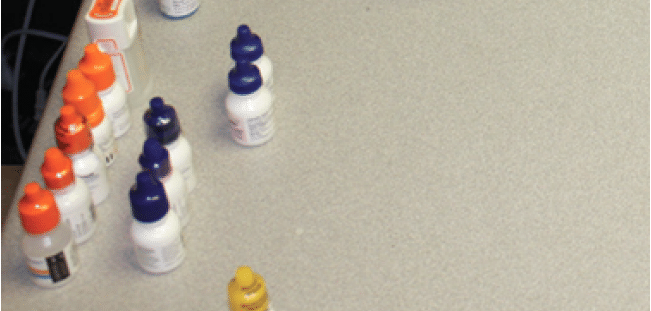
There has been a lot of focus on the side effects and other reasons why people may not comply with their treatment regime, but no one had focused on the bottles themselves. Anecdotally, lots of patients complain about the drops being hard to dispense. “It’s one big barrier that we haven’t evaluated before but it’s one that clearly patients are complaining about,” said Moore. Glaucoma also tends to be a disease which affects older people, who may not have as much strength in their fingers as younger patients.
Moore set out to look at three areas of eye drop bottles:
1.The current regulation for bottle specifications. He discovered that the only FDA requirements for eye drop bottles is that they contain the medicine intact for its useful life.
2. The number of drops per bottle and the variability between bottles
3. Bottle dynamics and the amount of force required to dispense drops
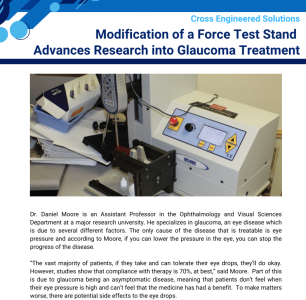
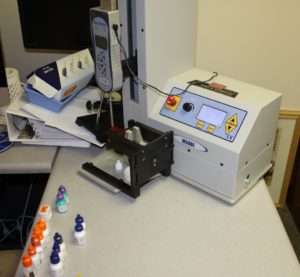
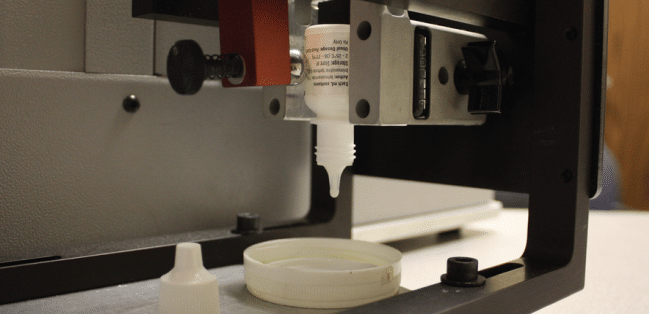
To measure the force required to dispense the drops, Moore contacted multiple vendors and a manufacturer and was eventually was put in touch with Cross Company. Said Kevin Hatch, Cross’ Director of Engineering, “He was obviously very passionate about doing the study. I had the feeling that no one else was listening to his needs, especially in terms of the different bottles.” The project involved modifying a Mecmesin M500E, an off-the-shelf force test stand, to hold the bottle and press on the sides (force stands usually press on the top of an object), all while upside down. For Cross Company’s engineering team, this involved overcoming two
main challenges:
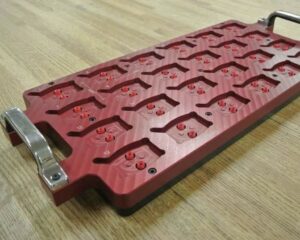
1. Holding many different sizes and shapes of bottles, some oval, some round, all the way down to single dose vials. To do this, the team made adjustable clamping jaws, which held the bottle in position but not too tightly.
2. Simulating patients’ fingers on the sides of the bottle. They put one ball on each side of the adjustable jaws to simulate fingers. An arm then attached to each ball, which was in turn connected to the force tester.
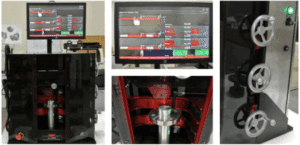
The system also recorded all the results automatically to a database. Said Hatch, “We listened to his needs and we customized the instrumentation to meet them, while keeping it easy to use.”
Using the stand, Moore discovered that there is a wide range of force required to dispense a drop. It varies between bottles, within the bottle – depending on the amount remaining in the bottle – and with the angle the bottle is held at.
“As a doctor who is trying to prescribe a medication, I have no idea of how hard it is for the patient to properly dispense the medication,” said Moore.
“The research has led to a couple of papers we are submitting to ophthalmological journals but the biggest goal is to lead to a change at the federal level, with standardization of bottles, that will improve the quality of care and outcomes for patients.”
Moore wanted a method of measurement that was as objective and as reproducible as possible, so others could build on his work. He said that the test stand was “easy to use, especially for someone without a background in engineering. I tested something like 2-300 bottles, with 150 measurements per bottle and it works just as well now as it did for the first one, so it’s very durable.”
Moore also found working with Cross’ engineering department very easy. He said, “It was very pleasant. I had great customer service, especially over email. They showed me exactly what they were proposing to do with photographs and how they were progressing. There was some back and forth regarding design but once I was happy, they calibrated it and sent it. It was fairly easy to figure out the set-up and when I called, they were helpful with the troubleshooting, especially the software.”
Moore is pleased with the results of the study but cautions “my method was as objective as it gets, but the variability that we found with the machine is only compounded by the real world, with real patients.” If his research leads to bottle standardization, at least one obstacle has been removed in the successful treatment of glaucoma.