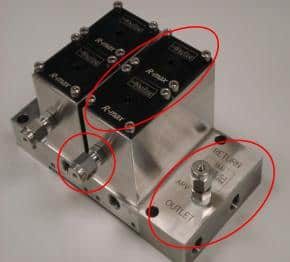

Product Spotlight: Parker Gen II R-Max

Parker Logo

Parker's Stream Switching System - Great New Features!

Parker’s Gen II R-Max is designed to control both gases and liquids in analytical systems ranging from vacuum to 500 psig while requiring only 65 psig actuating air pressure – talk about improving product reliability and reducing your cost of ownership.  It’s designed to be used in the chemical, analytical, petrochem, and oil & gas industries.

Product Spotlight: Parker Gen II R-Max 1

Enhanced design features include:

  • Captured vent – eliminates cross contamination, threaded connection, 1/8″ & 1/4″ SS tubing // , 1/8″ & 1/4″ plastic tubing // plug.  Plus, the vent fittings may be on opposite sides of the valve, the same side or connected in series
  • Position indicator – positive identification color band, backward compatible, available on all R-Max versions (except Single IntraFlow)
  • Effortless cartridge removal – position indicator design allows for easier removal of cartridges for maintenance
  • Alternate Ref GC – atmospheric reference separated from sample stream vent, internal fast loop available with this option, backward compatible to original R-Max

The Gen II R-Max utilizes surface mount technology to reduce leak paths, internal volume and dead volume. With surface mounting, system components may be easily removed and replaced without breaking process conditions, plus the system utilizes an internal self-purging outlet header to eliminate the need for an additional outlet loop.

There is also an ISA/ANSI SP76 option for the Gen II R-Max

  • Actuation air inlet from the top of valve body
  • Substrates are the same as modular R-Max
  • Substrates will be different for GC reference

Latest Cross Company Updates

From beer to soft drinks, high-quality, food-grade hoses are necessary to enable a clean, sanitary, and safe fluid transfer during the production process. See how a solution from Parker can help improve your process.
October 1, 2026
We’ve added solid metal conductivity and torque multipliers to our 17025 scope in Atlanta! See what else we’ve added!
September 28, 2026
Cross Logo
When dealing with older machined components like plastic injection molds or stamping dies, maintaining and restoring tools without existing CAD files can be a massive hurdle.
September 10, 2026
It is obvious that for the process to work efficiently and without problems, it is necessary to choose the right equipment in the right places for the process. This once again proved to be true, when Michigan Sugar was facing problems
September 8, 2026
Gases like hydrogen, helium and oxygen are in higher demand than ever before. This means the equipment used in these units and applications must maintain its reliability and provide longevity within the process.
September 8, 2026

Contact our Team

"*" indicates required fields

This field is for validation purposes and should be left unchanged.
What can we help you with today?*

Where Can We Send Your Information?

Name*
Company Location*
Form Type

Hang Tight! We're Searching... Searching... Searching...

We’re looking through thousands of pages to find the most relevant information.

In the meantime, enjoy these fun facts…

Did you know… Cross Company is an ESOP (Employee Stock Ownership Plan). Our ESOP started in 1979 and as of 2006, we are 100% employee-owned! Learn more about our ESOP and how that benefits both team members and our customers.
Did you know... the precision measurement group at Cross was founded in 1939 by our current CEO's grandfather, Jim King. That's a whole lot of calibration!
Did you know... A fingerprint weighs about 50 micrograms. We know, we weighed it! The residue left from a finger can actually make a difference in weight results which is why we wear gloves when we calibrate weights. For reference, a sheet of paper is about 4.5 grams, that’s 4.5 million micrograms.
Did you know… Cross Company has grown significantly since our start in 1954. Over the years we've acquired 26 companies! Today, our five groups have expertise in everything from industrial automation to precision measurement, and industry knowledge going all the way back to 1939.